
According to RCOT, delays in providing community equipment are now a major factor in delayed discharge. 74% of equipment providers report discharge delays linked to unavailable equipment. NHS data says dealing with stairs is the first change required to the home and help with stairs is among the top three most common home adaptations(1).
At AAT GB, we are pioneering ways for OTs to take steps, address long waits and discharge delays resulting from inefficiencies in community equipment recycling/redistribution.
We were the first in the sector- and the only ones with national capability- to create a bespoke package to optimise recycling and redistribution of community equipment.
The result is our re-issue programme for our top-selling mobility stairclimber.
Class 1 Medical Device certified, our S-Max Sella stairclimbing wheelchair is battery-powered and completely portable.
It makes traversing stairs- and onward- safe and easy, without any need for disruptive equipment installation/fixing.
There is no disturbance to your client’s home environment, nor the family’s routine, dignity and privacy.
Our Sella stairclimbers are in almost all local authorities' community equipment inventory.
So our scheme means someone can be discharged from hospital, or their home environment made safe, quickly and cost-effectively: the package costs <£1500.
Under the scheme, we support OTs with an in-depth PEOP assessment of client, carer(s) and the home environment, service and set up the mobility stairclimbing wheelchair to the client’s requirements then personally train the care team in the equipment’s safe use.
Mark Roberts, AAT Director- “Re-issue of our Sella stairclimber means someone with reduced mobility is enabled to get home, or remain in their home, safely.
"The Director of Practice and Innovation at the Royal College of Occupational Therapists, Karin Orman, said: ‘Access to the right equipment is not a luxury, it’s essential for people to be safe in hospital and at home. Not having the right equipment can put people at serious risk of harm.'
“Our re-issue package spares that risk, and does so fast and cost-effectively, helping make the most of already stretched financial resources.”
Full details of our re-issue package and services for OTs can be found here: http://www.aatgb.com/ots/

38% of disabled people live in rented accommodation(1). Mobility is the biggest disability issue(2).
Being a portable piece of equipment, our stairclimber is classed as an auxiliary aid.
Our stairclimbing wheelchair overcomes the issue of stairs limiting accessibility.
It works whether in a rented house or common parts in a MOU (multiple occupancy unit).
Unlike the conventional alternative of a stairlift or through-floor lift, our battery-powered S-Max stairclimber requires no physical or structural change to the home.
Once the client is sat on the S-Max, there’s no need for intermediate transfers until the destination is reached.
Their carer just pushes a button and guides the S-Max from room to room, up and down steps and stairs.
S-Max solves accessibility and mobility for more than one disabled tenant.
Our equipment helps numerous disabled tenants overcome their mobility limitations over its average 15 year lifespan(3), using our unique re-issue scheme.
Nor is additional capital equipment funding/ DFG allocation(4) required.
“In our 25 years’ experience, we find S-Max can solve the problem of stairway access in 90+% of scenarios,” observes Peter Wingrave, AAT Director.
“S-Max provides a fast, safe, cost-efficient way to enable people to remain in their homes.
"People are no longer at a substantial disadvantage in their home, unable to access various floors or go beyond their front door.
“Something as simple as re-allocating a stairclimber could avoid disabled tenants having a sense of isolation and inaccessibility. And most local authorities already have our stairclimbing wheelchair!”
Full details of AAT’s S-Max, and the company’s re-issue facility, are available on its website @ http://www.aatgb.com/ots/ and http://www.aatgb.com/s-max/
references:
(3)http://subject to appropriate assessment, care and servicing.
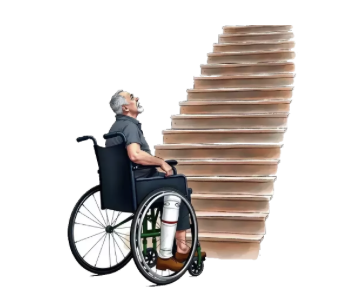
Almost every home has stairs, whether to gain access if a flat, or to move around the home if a house.
For the patient to be able to continue with their daily life, they need intervention. Delay waiting for modification causes bed-blocking.
Where appropriate, Occupational Therapists have an easy intervention available for prescription- an S-Max stairclimbing wheelchair.
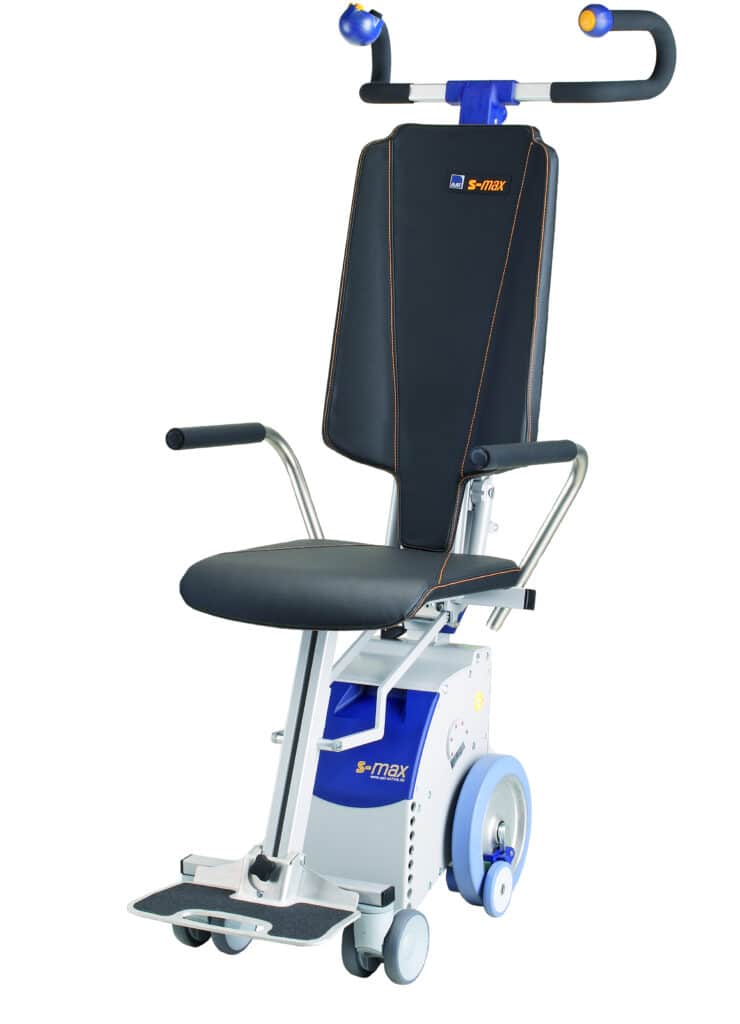
The battery-operated kinematic Class 1 Medical Device can either fit to a wheelchair or include an integral seat (the S-Max Sella), to safely transfer the injured person up and down steps and stairs. The person overcomes the barrier of wheelchair stair access.
There is no installation, fixing to walls, floors: all that is required is an hour or so’s training, provided by AAT.
Lightweight and mobile, the S-Max mobility stairclimber can be used by even the most petite operator. It folds away when not in use.
With the addition of a Universal Back accessory, any additional thorasic or pelvic support required can be achieved- whether for the initial recipient or future beneficiaries.
Most local authorities have the equipment already, so it is just a case of re-issuing from stores.
If one is not to hand, AAT’s assessment managers can visit the patient within days. A stairclimber delivered from stock within 3 days of receipt of order.
That purchase can then be used to support the specific person, then taken into stores and re-issued to others.
In this way, Occupational Therapists achieve a person-centred solution.
They manage risk of the injured person falling on the stairs.
Their client's environment and ability to perform routine occupations is also safely addressed.
Thus, Royal College of Occupational Therapists’ guidance on falls management(3) is followed.
And the person is discharged from hospital, releasing the bed.
“Prescribing a stairclimber is a best-value way to achieve a broad, holistic answer to a client’s ability to be discharged faster from hospital, and live home life better, with less disruption to routine,” explains Peter Wingrave, AAT Director.
“It is the most efficient way to overcome the issue of navigating stairs, removing all the danger of someone trying to go up or down on crutches (an accident waiting to happen), the indignity of bottom-shuffling, or them being confined to one level with all the disruption to them and the rest of the household in moving beds downstairs, commodes etc. With its re-issue capability, one stairclimber can help numerous people.”
Ful details of the S-Max, including videos on it in action, and an assessment booking form, can be found on AAT’s website: https://www.aatgb.com/s-max/.
references:
(1)https://www.jla.nihr.ac.uk/priority-setting-partnerships/broken-bones-in-older-people#:~:text=priorities%20Key%20documents-,About%20this%20PSP,as%20the%20population%20gets%20older.
(2)https://www.jla.nihr.ac.uk/priority-setting-partnerships/broken-bones-in-older-people/
(3)https://www.rcot.co.uk/node/396

The Council's achieved a green alternative to social care by allocating AAT’s Sella stairclimbers (stairclimbing wheelchairs), where appropriate, to clients needing help with stairs.
The Department used grant funding from the Council’s Green Investment Fund to purchase four Sella’s to provide an alternative to major adaptations that reduces the carbon impact of building.
In this way it has achieved a green alternative in social care provision.
Stairclimbers are mobile, portable devices- unlike conventional stair solutions such as stairlifts or through-floor lifts which require structural surveys, installation and building works. No building work is required.
The Department can re-issue-re-cycle the Class 1 Medical Device to another person when the original recipient no longer equires it. There are no building works to ‘make good’. The equipment's green credentials- and best value capital outlay- are enhanced.
To further extend the capability of the stairclimbers, the Department has also bought three of our unique Universal Seating System.
The Seating System combines back, seat, lateral and foot supports with safety harness. It ensures each user is completely supported and safe when being transferred up and down stairs.
Sarah Hole, Children’s Senior Practitioner Occupational Therapist for the Integrated Community Equipment Loan Service Clinical Team Nottinghamshire and Nottingham City Partnership, says:
“We historically have purchased AAT stairclimbers for use, where appropriate, with children and adults who have impaired mobility. The fact that they can be deployed quickly, with none of the impact of building work, makes them a useful alternative to major adaptations. It especially helps as budgets are under pressure and there is a drive to become carbon net zero.”
Dr Cate Bennett, Principal Occupational Therapist, Adult Social Care and Health at Nottinghamshire County Council, adds:
“The Principal Occupational Therapy role focuses on leading the quality assurance of occupational therapy practice, service development and improvement. It has a strategic and operational focus, and covers work within our organisation, and externally where it furthers the development of social care and occupational therapy.”
Mobilty is the biggest disability in the UK(2). Stairs are the second most common hazard in the home(3, and one of the three most common adaptations.
Our stairclimber re-issue capability(1) is unique in the inter-floor transfer sector, and is rapidly gaining momentum among local authorities nationwide as a cost-effective and quick way to keep people safe and in their own homes by managing the risk of stairs.
REFERENCES:
(1)https://www.aatgb.com/taking-steps-to-reduce-adaptation-delay-for-650-recycle/
(2)https://www.statista.com/statistics/449279/disability-prevalence-impairment-united-kingdom-uk/
(3)https://bregroup.com/press-releases/bre-report-finds-poor-housing-is-costing-nhs-1-4bn-a-year/
Everyday activities can become a daily challenge when walking, balance, or strength aren’t what they used to be. When your or your loved one's mobility is reduced
Whether it's due to injury, chronic illness, aging, or disability, getting on with life takes courage, and sometimes a little help.

Until you're faced with reduced mobility, you've no idea what's out there to help!
And however comprehensive a website FAQ section may be, however clever AI is, when your loved one’s health and mobility are affected, you can’t always find the answers.
You need a conversation. A chat with a person.
Because everyone is different. How physical or mental disability affects us varies with each person. So whether you need help getting round the home- inside AND out- or in almost any seated position/activity- from a bath to a boat and everything inbetween- call us!

T: 01327 340 083.
You may also like: https://livingmadeeasy.org.uk and https://www.independentliving.co.uk

Help with stairs and steps is one of the top three most common home adaptations people need to their home(2)..
Our innovative S-Max Sella stairclimbing wheelchair (stairclimber) is unique in that, unlike the conventional alternatives, it addresses BOTH internal stairs and external steps when adapting a home.
Sella means that Occupational Therapists need prescribe only ONE piece of equipment to enable someone to access all levels of the home- inside AND out. They can use it for either or both scenarios.
OTs can re-cycle/re-issue it to another client when their original client no longer needs it- unlike the alternative conventional solutions.
We have put in place a specific service for social care providers to enhance that flexibility, whereby we manage the whole process for the OT.
That includes:
- assessment of the potential recipient
-assessment of their home environment to validate the suitability of the equipment
-training of the recipient’s carer
-stock-holding, servicing and commissioning of the equipment between each home adaptation.
Our package works out at less than £650/yea (3) over the 15 years’ average lifespan of the Sella helping numerous people in need of stair and step support in the process.
Director Peter Wingrave says:
“The Government’s package of support as part of its Plan for Change acknowledges the two-edged sword of the need to take preventative steps that help people remain in their homes, out of hospital and that we have an ageing society."
“Our package of support provides a best value option to address one of the most common changes required to a home. There may be extra Government funding in the pot, but it makes sense to optimise the value of every £. That way, more people can be helped to stay in their own homes.”
Full details of our S-Max Sella and package for social care providers can be found here: https://www.aatgb.com/ots/.
You may also like:
https://www.aatgb.com/taking-steps-to-reduce-adaptation-delay-for-650-recycle/https://www.aatgb.com/cradle-to-grave-evolution-simplifies-speed-and-safety-on-stairs/
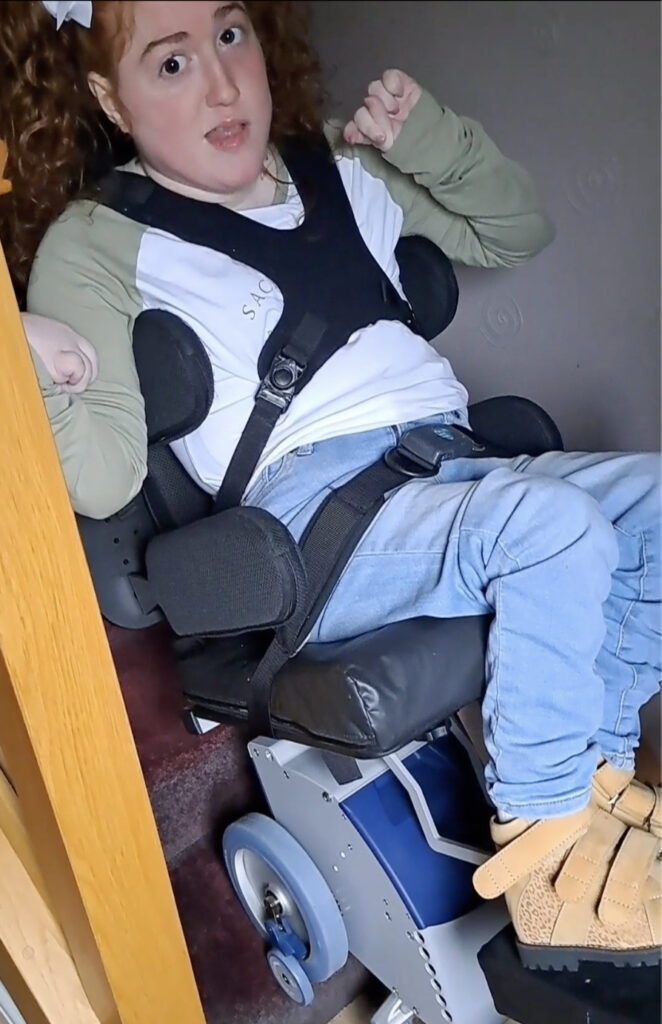
The 17 year-old has complex disabilities, including seizures and being non-verbal. Her parents Melissa and Darren themselves have health issues.
They were finding it a risk getting Rhianna up and down stairs.
But the design and size of their house meant it was not viable to use the conventional solutions- a stairlift or through-floor lift.
Rhianna’s Occupational Therapist at Calderdale and Huddersfield NHS Trust found out about AAT’s Sella stairclimber. She reached out to us for assessment support.
Our Sella worked!
See how the Sella stairclimbing wheelchair works here: http://www.aat.com/s-max-sella/
In Medequip’s stores for Kirklees’ Council, a Sella stairclimber was available. Some of the accessories needed to ensure Rhianna was sat secure and properly supported as she needed were also there.
As a result, using the re-issue capability of the stairclimber, Rhianna’s carers can now transfer her up and down the stairs without risk to her or themselves.
Melissa and Darren can safely pause the stairclimbing process should Rhianna have a seizure en route.
Our re-issue facility for stairclimbers is unique within the sector.
Our re-issue means that- where appropriate- necessary, reasonable and practical changes can be made to make stairs safe for someone with reduced mobility, for <£1000/ £650 pa(1).
There are no structural alterations nor permanent restriction of the stairs for other members of the household.
You can find out more about our re-issue opportunity here: https://www.aatgb.com/taking-steps-to-reduce-adaptation-delay-for-650-recycle/
Mum Melissa says:
“It’s been a real life saver! Rhianna’s face shows that she enjoys it, and it’s made the world of difference to us all.
“It was a bit scarey to start with at the top of the stairs, but AAT trained us fully in how to use the stairclimber safely.
"If Rhianna has a seizure, we just stop until it’s passed and we can resume.”
Adds our Gareth Brown ,
“Rhianna requires significant support to sit. We had most of the accessories she needed in stores @ Kirklees, so there was only need to purchase a couple of small additions.
"Her access to all levels of the family home has been made safe, including assessment, equipment and training, for around £1000- a fraction of the cost of other solutions, had they been viable.”
(1)Sella purchase price £4650, re-issue x 3 @ £995/ re-issue= £2985/12 years (lifespan of. Sella) = £636/annum.
The core re-issue package (£995/re-issue) includes client assessment and full training of two carers.
Estimated reading time: 3 minutes
What equipment to help with stairs for your special needs children and your family, especially once they are too big to be carried around…?
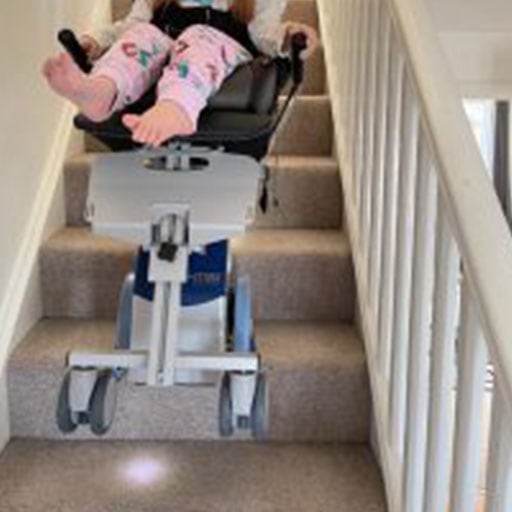
In an ideal world, you’d adapt the home or re-house the family into somewhere more suitable.
The reality is that takes time, if it’s even possible, and you have a duty of care to manage the risk- whether for the short- or long-term.
I say even possible because the truth of the matter is that:
-80% of the homes we need by 2050 are already built.
-20% were built before 1919 and
-50+% are conjoined (semi’s or terraces).
Most homes are houses: they have stairs!
Are they structurally suitable to be adapted- in their design, space, wall strength etc? Is there space outside for an appropriate extension?
And we all know, all too well, the issues with social housing waiting lists.
From a practical perspective, the issue is complicated by the fact that often the children lack control over their bodies.
You have to take into account the likelihood of their thrusting arms or legs out, flailing, spasms and seizures.
You need a way to overcome the need to access up and down stairs, safely. It's hard for you to negotiate a dozen or more steps with the weight of your child in your arms. It's hard when you are trying to maintain balance with a child who most likely is not lying there quietly without moving.
There are four core choices: move your child’s bedroom downstairs, a stairlift, a through-floor lift, or a stairclimber (stairclimbing wheelchair).
Your choice is influenced by:
It seems the logical option, as it instantly removes the issue. But it is dependant on the size and scope of the home.
You need to be space to accommodate your special needs child’s bed and all their accoutrements.
What about the impact this has on them, and, as importantly, other member of the family in everyone’s use of the home and daily activities?
It also means your child’s personal space and privacy is adversely impacted.
Many parents do not like their child being so far away at night, in case they are needed.
You also need to have at least a downstairs WC and ideally either an existing bathroom, or the scope to add one.
If you don't have these in the existing layout, often an extension (permanent or relocatable) is added, but again there needs to be the external space to accommodate that, plus access to drains, electricity etc.
This is your ‘go to’ conventional solution in adaptations.
However it depends on the staircase design and the structure, specifically whether is strong enough to bear the load. That requires a survey. That equals delay.
Today’s versions are available with child accessories- seats, harnesses, foot rests etc.
Remember, for your child to use it safely, they need mobility, sitting balance and control over their body movement.
He/she is sat perpendicular to the stairs. You need to be sure there is no risk of them sticking out a leg or arm that may catch on the banister and newel posts, nor panicking.
It is a permanent fixture, physically attached to the building fabric, so therefore restricts unimpeded stairway access for others in the household.
Through-floor lifts, as their name implies, require a suitable space both upstairs and down- on average, 1m2 as a ‘footprint’, with a ceiling height of at least 2.1m.
They require cutting of a hole in the ceiling/floor. They require a survey to assess the property’s suitability.
Models can accommodate someone in a wheelchair and a carer. You have to be confident both can fit inside comfortably and safely, whether your child is in a wheelchair or being carried.
A battery-operated free-standing, portable, mobile unit that can be attached to the child’s wheelchair or have an integral seat.
You don't need a structural survey to assess for weight-loading as the stairclimber is a portable piece of equipment, it is not fixed to the structure.
Capable of climbing most common staircases, it can then taking your child onwards to other rooms within the house without an additional transfer.
You achieve a safe stairway transfer solution within days of assessment.
Your child is transported in line with the stairs, slightly inclined backwards reducing risk of panic and the risk of arms, legs getting between newel posts.
When you're not using it, it folds compactly away and can be stowed in a cupboard.
Your child is comfortable, safe and secure when using the equipment as it can be accessorised to suit their individual needs.
The S-Max Sella stairclimber
Class 1 Medical Device certified, the Sella is the only stairclimbing wheelchair which is backed up by full, nationwide sales and service support and with a track record stretching back 20 years.
The Sella stair walker is the market leader, with more than 5000 units in use with Local Authority and NHS Trusts across the country.
It is also the only stairclimber with a bespoke, purpose-designed all-in-one paediatric seat- the Universal Back.
Our Universal Back, developed with Occupational Therapists, features head, lateral and seating supports and harnessing.
We can precisely set the accessories exactly as your child needs for optimum comfort, postural support and alignment, and physical and emotional security.
As your child grows, we can adjust the supports.
And, if your child is likely to have. seizure, don't worry!
You can safely brake and pause the Sella at any point during the transfer.
We show you how in the 1:1 training we give you in your home as part of the process.

All you need in addition is training by a qualified professional: we check and service the Sella as part of the re-issue package.
There is none of the inevitable ‘making good’ of the home required with stairlifts, through-floor lifts.
That all helps you persuade your OT to prescribe one!
You can see it in action here: www.aatgb.com/s-max-sella.
I would hope you now feel more aware of the options, how they differ, and how to make stairs safe for a special needs child.
I have shown you how to manage the risk and make accessing the home safe for all involved, whether for the short- or long-term.
Our website has a raft of support material that may help, including user testimonials, videos, and guides. And you can book a free, no obligation assessment: https://www.aatgb.com/mobility-stairclimbers/
Author: Gareth Brown, AAT Technical Director
You can find out more about our Sella stairclimber here: http://www.aatgb.com/s-max-sella/
Want to know why to choose the Sella? Ewe've identified six reasons why: https://www.aatgb.com/six-reasons-why-to-choose-a-sella-stairclimbing-wheelchair/
You may be interested in:
https://www.aatgb.com/disabled-children-and-stairs-an-accident-waiting-to-happen
https://www.aatgb.com/steps-and-stairs-overcoming-the-obstacle/
and https://www.aatgb.com/family-chooses-quick-fix-tech-as-the-ideal-long-term/

We are launching an innovative service specifically for social housing organisations, aimed at making the social housing stock work for everyone, making homes more accessible, without any structural alteration.
The service centres around our #1 selling S-Max Sella stairclimber (aka stair climbing wheelchair) combined with the unique Universal Back accessory.
The combination means that almost anyone with a mobility issue- the most common impairment felt by the 6.2million social housing tenants who are disabled- can access all levels of their home and get safely in and out of a MOU (multi occupancy unit).
It means many inaccessible homes become accessible, enabling the SHP to balance the needs of the tenant and its housing stock for less than £1500/tenant(1)/without Disabled Facilities Grant funding.
Importantly, the S-Max Sella requires no installation nor structural fixing. Thus in individual homes there is no need for structural survey and in MOUs- which account for more than 35% of housing stock, there is no impact on common parts.
The equipment can be recycled/ re-issued to other tenants when no longer needed by the original recipient.
Our service is a flexible package with options including assessment of the tenant and their home to determine suitability, provision of the equipment, training of the tenant’s carer(s), annual service & maintenance of the equipment in line with LOLER regulations, and management of the social housing provider’s stairclimber stock.
Buying in to our service means the housing provider makes inroads into compliance with the Equality Act Section 36, and the new Building Safety Act with regard to safe, fast evacuation of disabled tenants.
In essence, the S-Max is a portable kinematic, battery-powered device that ascends or descends steps, at a rate set and controlled by the carer. AAT’s Class 1 Medical Device certified stairclimber will execute 300 steps from one charge.
AAT’s Universal Back accessory can clip-fit to the unit if required to provide supplementary support to each user’s needs.
“Adopting a strategic plan such as utilisation of our facility enables the SHP to cost-effectively meet the needs of the tenant for little outlay and no disruption to the housing stock.
“It means a tenant with reduced mobility in an upstairs flat is no longer housebound. Their safety in the event of fire is protected. It potentially extends the scope of available housing.”
Peter Wingrave, AAT Director
Established 20 years ago, we have built a reputation as the stairclimber people. Thousands of units are now in regular use throughout the UK and have an impeccable safety record. AAT GB is the only supplier in its sector with the depth of kit and service to support SHPs in its obligation to disabled tenants.
For further details of the S-Max Sella and Universal Back visit: https://www.aatgb.com/mobility-stairclimbers/.
For further information about the social housing service, email sales@aatgb.com or telephone 01978 821875.
ENDS
Reference:

AAT’s top-selling battery-powered, mobile Class 1 Medical device the S-Max stairclimber/ stairclimbing wheelchair requires no installation or structural fixing nor modification.
Thus- as specified in the DFG Guidance section 2.30(1)- its provision can be covered by minor adaptations from social services. The time and delay involved in applying for Disabled Facilities Grant funding is eliminated.
The S-Max expediates a person-centred approach, enabling the client to remain at home without disruption to daily/family life.
Prescribing an AAT S-Max potentially expediates a dual-purpose safe transfer/fall prevention option.
The solution has even better use of budgets: with thousands already sold to local authorities over the past 20 years, there may be one already in Community Equipment Stores. This can be re-issued within days.
The battery-powered S-Max smoothly and kinematically ascends and descends steps and stairs. It can be fitted to a wheelchair or be supplied with an integral seat (the S-Max Sella).
It can handle most staircase designs, and complete 300 steps from a single charge. The rate of ascent/descent is set by the operator (care giver), via AAT’s innovative ComfortStep technology, including an energy stop function.
A range of accessories, including AAT’s pioneering Universal Back, means the S-Max can be configured for almost every client from small infant to obese adult with due care and support for their particular physical or mental disability.
The unit itself has full adjustability so it can be quickly set up to exactly suit each operator, making it particularly suitable for clients with several members in the care team.
Full details of the S-Max, and the tool to book a free no obligation assessment ca be found on AAT’s website @https://www.aatgb.com/mobility-stairclimbers/.
(1) https://www.gov.uk/government/publications/disabled-facilities-grant-dfg-delivery-guidance-for-local-authorities-in-england/disabled-facilities-grant-dfg-delivery-guidance-for-local-authorities-in-england


