We are stepping up to the challenge with a raft of measures to educate social housing management and staff on ways they can help residents, whether they live in a flat, house or bungalow with steps outside.
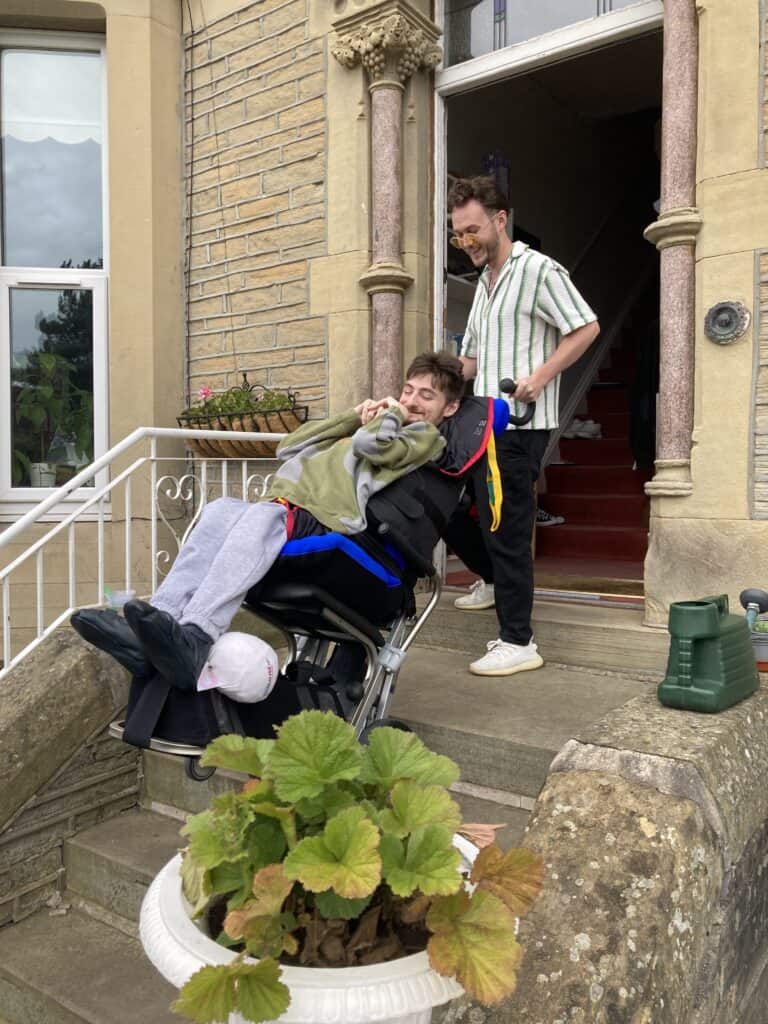
The measures include running a free of charge training session on one way to address the limitation of lift/stairs/steps, via utilisation of a stairclimber (stairclimbing wheelchair).
Our session includes initial support advice for the tenant as to their options in terms of disability equipment/adaptations, demonstration of the equipment and its various options and accessories.
It further covers how the equipment can safely be deployed to enable access without obstructing common parts.
When social housing providers purchase an AAT stairclimber, we will train staff, the recipient and carer(s) in how to use it and will set up the stairclimber for the user.
When the tenant no longer needs it we will take the stairclimber back, service it, then repeat the process for the next recipient.
“More than half (54%) of social housing renters have a disabled member of the household and mobility is the most common impairment.
"Social housing providers have a duty of care for their tenants to enable them free access to and from their homes. Having appropriate training and measures in place to deal with the problem is therefore paramount and fundamental” says Peter Wingrave, AAT Director.
“Our stairclimber is a unique solution in that it is portable, requires no installation and is not fixed to the home in any way.
"It can therefore quickly ensure a tenant CAN get in and out of their home, and around it, safely, enabling them to live their daily life and reducing risk to their mental health.”
AAT’s S-Max can travel 300 steps from a single battery charge- equivalent to a 20-storey block of flats.
The standard unit can be easily attach to most common wheelchairs. The Sella version incorporates an integral seat with support arms and harnessing for optimal safety for the passenger.
Using a stairclimber, the disabled tenant becomes able to get in and out of the building, into their home and into the outside space and beyond.
It's becoming increasingly popular to use stairclimbers in social housing- be it local authority or Housing Association and is proven in practice from East London to Yorkshire.
Stairclimbing wheelchairs are a cost-effective, non-disruptive way of enabling the tenant to remain in their home.
And they help social housing providers meet their legal obligations and to provide safe access/exit, whether short- or long-term.
Our stairclimbers have an impeccable safety record stretching back over 20 years.
Full details of AAT’s offering for professionals and the S-Max stairclimber can be found on https://www.aatgb.com/ots/
*https://assets.publishing.service.gov.uk/media/651bed026a6955001278b1c8/Disability_support_and_social_housing_-_wave_2_focus_group_Resident_Panel_report.pdf


