
The good practice guidance recommends that as soon as possible after admission, the care boards consider the home environment so any issues can be addressed in advance of the patient’s return.
Any intervention needs to be timely, safe and person-centred. Latest data shows that waiting for community equipment/adaptation to the home is often the reason why people are still in hospital(1).
Utilising AAT’s package, the board can effect a proven, safe means of making the home accessible to the patient when reduced mobility is influencing their discharge.
There is no need to re-organise current living arrangements/furniture nor install any fixtures.
When the patient no longer needs the S-Max stairclimber (stairclimbing wheelchair), AAT will take it back, service it, then re-issue to the next patient who needs help with stairs even if just for a few weeks(2).
Risk management and best value are achieved.
“It’s a win:win option,” says AAT Director Peter Wingrave. “We can visit the patient’s home, assess and train their care supporters and set up the S-Max Sella to the patient’s specific needs within days of being instructed. The S-Max is portable and compact, and battery operated. So there’s no disruption to the home, and it folds away when not is use. When no longer needed, we’ll collect it, service it, and re-issue to the next person who needs mobility support around their home to enable their discharge.
“Because our team is fully trained in assessment our re-issue package takes the pressure off the teams involved in community rehabilitation and almost eliminates the inherent delays arising from funding streams (eg DFG).”
Class 1 Medical Device certified, AAT’s S-Max Sella stairclimber (stairclimbing wheelchair) delivers on all the key aspects of a therapy-led intervention.
In the 20 years it has been prescribed in the health and care sector, it has proven its relevance in 90+% of cases, enabling the recipient to be safely moved up, down stairs and onwards.
The unit can be adjusted to suit each person: even the most petite carer can safely use it, even with a bariatric passenger.
Fitted with AAT’s unique Universal Seating System, the Sella can be set up to achieve the security and support each individual needs, from child to elderly dementia sufferer.
Full details of the discharge service can eb found on AATs website- https://www.aatgb.com/ots/.
References:
(1) https://www.england.nhs.uk/statistics/statistical-work-areas/discharge-delays-acute-data/
(2)subject to terms and conditions, and assessment of the home and users.

Adopting a policy of funding recyclable equipment could simultaneously address the multiple facets of:
- enabling people (young or old) to remain safely in their own homes,
-avoiding their admission into residential care,
-providing short or long term support to facilitate hospital discharge
-stretched social care finances and
-managing the risk of falls by preventative measures.

Importantly, the comparative low capital cost of buying just one stairclimber (stair climbing wheelchair), that can be used over its lifetime by numerous people, achieves best value.
With our S-Max Sella typically providing a practical working life of 12 years, its annual cost- including re-issue to an average three people during its life, equates to less than a typical week of residential care(1).
“Mobility- with its associated issues of getting up and down stairs and falls- is possibly the biggest single reason why social services have to find- and fund- a solution, whether it’s a home adaptation or someone going into care,” says Peter Wingrave AAT Director.
“Even acknowledging a stairclimber is not a solution in every case (albeit in our experience being the answer in 95% of cases where stairs are a problem), its provision can be a disproportionately significant step in easing the financial constraints being faced by Councils up and down the country.”
Full details of AAT’s S-Max Sella and re-issue facility can be found on its website www.aatgb.com.
With our innovative re-issue capability, one of our stairclimbers can help support multiple clients in need of social care to address mobility and difficulties with stairs in- and outside- their home. Full set-up to each recipient and training is provided.
ENDS
(1) http://(https://www.ageuk.org.uk/information-advice/care/paying-for-care/paying-for-a-care-home/Residential care cost of £800/week S-Max Sella purchase price £4650, re-issue x 3 £3000/ 12 years= £637/annum.

With its unrivalled market penetration and expanded team of professional assessor, engineers and trainers, AAT has a unique ability to help OTs maximise use of available equipment to manage the risk of reduced mobility and stair access, for clients of all ages.
The AAT S-Max Sella is the most widely used stairclimber/stairclimbing wheelchair in the UK, with thousands already purchased by local authorities.
AAT has now doubled its team of service engineers/trainers, giving OTs “the boots on the ground” to effect safe stairway access within days, for <£650/year(2).
AAT offers FREE NO OBLIGATION assessment(3), providing the OT with detailed clinical reasoning as to the suitability of its #1 selling S-Max Sella stairclimber for the client, their carer(s) and their environment.
When no longer needed by the original recipient, S-Max Sella can be easily recycled/ re-issued to other clients.
Thus, AAT’s nationwide assessment, service engineer and trainer teams means that the OT can re-prescribe supported by an AAT assessor, the kit be thoroughly checked and serviced, and the carer(s) trained in its safe use ensuring stairway access- all enabled within days and for <£1000(4).
In 90+% of scenarios where stair access needs addressing, the S-Max Sella stairclimbing wheelchair can deliver a safe and appropriate solution.
The Sella is Class 1 Medical Device certified. It can be quickly and easily accessorised for each client- from a young child to an elderly bariatric person with dementia.
The standard unit can navigate almost all typical staircase widths and designs.
Battery powered and portable, there is no need for the delay of a structural survey, alteration nor installation, nor stairway impediment for other occupants of the house or block of flats.
As it is not fixed in any way to the home, there is no “making good” when it is removed and re-prescribed to another client, further optimising its cost-efficiency.
“Children’s and adults’ social care together make up the majority of core funded local authority expenditure(1),in some cases, up to 50% of the entire Council budget! Adult social care is the largest single area of core funded expenditure for local authorities in England. SEND services have increased by 115% in the nine years up to 2023,” says Peter Wingrave, AAT Director.
"The reality is that maximising use of existing equipment must be an over-riding consideration. In one of the most common areas to address- stairs- no other company has the ability nor capability to support OTs and effect a personalised, practical solution that can be so easily and cost-effectively re-prescribed.”
Full details can be found on this website: https://www.aatgb.com/ots/.
ENDS
References:
(1)https://committees.parliament.uk/publications/43165/documents/214689/default/
(2)S-Max Sella purchase price £4650, re-issue x 3 £3000/ 12 years= £637/annum.
(3)UK mainland
(4)Including full service, training of carer(s). Excluding any additional accessories
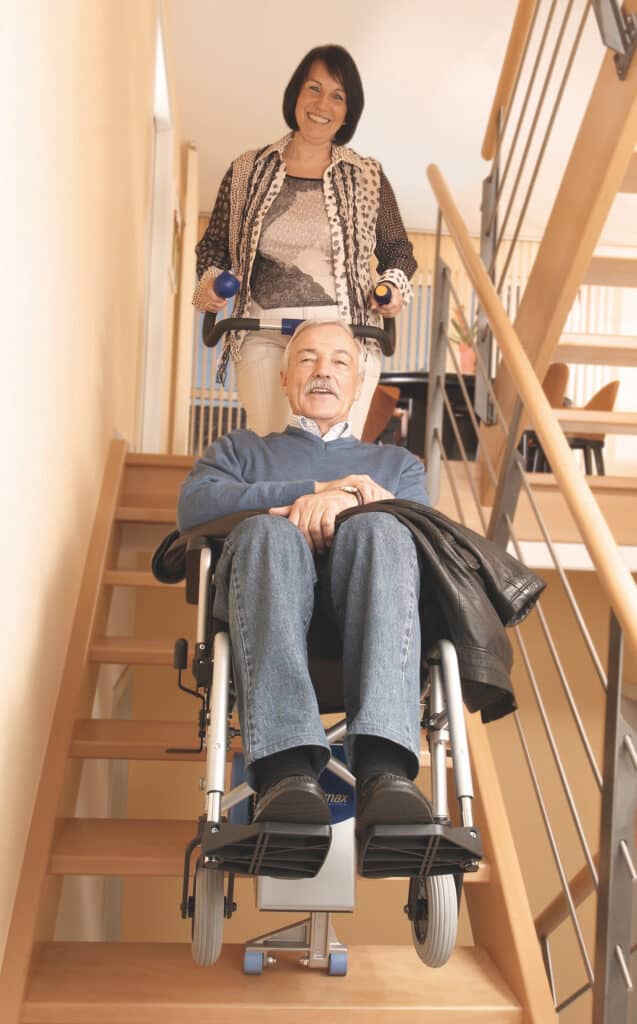
AAT’s solution goes beyond purely capital expeniture. It also protects against exposure to the risk of someone falling and possible hospital admission, or becoming trapped in their home because of reduced mobility.
It facilitates their discharge from hospital to the home environment rather than short- or long-term residential care with all its associated social care cost.
The answer centres around optimising use of AAT’s innovative S-Max Sella stairclimber/stairclimbing wheelchair.
The equipment can deliver a solution in 90+% of cases where stair safety is a consideration. It needs no structural survey nor installation. Importantly, almost every Council in the country now has at least one S-Max Sella on its books.
Thus, if one is available in stores, it can be re-issued to a new user without the financial outlay of buying additional equipment.
The initial assessment to check that the stairclimber will work for the client and their staircase is free of charge.
The only cost is that of the equipment servicing and setting up to the new client, and their training- all achieved for usually <£1000, a fraction of the cost of providing alternative stairway access.
"Surely in the current climate, low cost solutions to optimise use of existing equipment must be explored to the full.
“Enabling someone to get safely up and down the stairs has a significant knock-on effect- it removes the need for a way to create a WC, bedroom downstairs which either involves major disruption to daily life and loss of privacy, a costly and time-consuming adaptation or the person’s admission into care.
“To our knowledge, no other company has the penetration nor the scope to provide such a service as our re-issue package, to help make some contribution to ease the pressure on budgets.”
Peter Wingrave AAT Director
Full details of AAT’s re-issue package can be found @ https://www.aatgb.com/take-steps-to-deliver-adaptations-for-under-1000/.
ENDS
Reference:
(1) https://www.local.gov.uk/about/news/lga-statement-provisional-local-government-finance-settlement#:~:text=The%20LGA%20has%20estimated%20that,council%20services%20since%202021%2F22.
The Association of Directors of Adult Social Services (ADASS) claims in its latest Autumn Survey(1) that we need to shift to a preventative model of care and increase investment in recovery services to avoid a continuing cycle of crisis in winter.
Leading mobility supplier AAT says a change in approach to how existing availability of equipment is used could make inroads in the problem immediately.
Wider acknowledgement of the role and potential impact that non-fixed equipment such as stairclimbers and “people picker uppers” could have a significant impact on reducing pressure on social care and the NHS by managing the risk to older and disabled people.
Requiring no installation, the aids can be issued within days from Equipment Stores or AAT direct to make it safe for the older or disabled person to remain at home.
When the recipient no longer needs it, the kit can be re-issued/re-allocated/recycled to someone else.
AAT’s S-Max stairclimber can transform a wheelchair into a stairclimbing wheelchair, or with its integral seat (S-Max Sella), make stairway/step access safe for an older person with reduced mobility.
S-Max does not require installation. It does not obstruct the staircase/steps for other members of the household.
And it eliminates the need for a potentially dangerous transfer at the top of the stairs or steps. When no longer needed by the initial recipient, it can be re-allocated to someone else.

AAT’s range of people picker upper equipment safely restores an uninjured fallen person to a safe height to sit or stand without the delay of waiting for non-emergency services to respond.
Again, if employed at an individual’s home, when no longer needed it can be re-allocated- recycled- to someone else in need.

“The social care convention when someone’s mobility is reduced is to look at ramps, stairlifts- permanent, fixed solutions that take time- and money. More often than not, they also only benefit the initial recipient,” says Peter Wingrave, AAT Director.
“When funds and specialist staff are under pressure, surely it makes sense to look at options that deliver the necessary, appropriate risk management that offer better value and do not require social care staff input?”
He adds, “Social care and housing are inextricably linked. The reality is that 80% of the homes we will be occupying in 2050 already exist(2). We need fast solutions to help make our existing housing safer and more accessible so people can continue to live independently at home. Those solutions are to hand, available, already in use. It is only because they are not ‘mainstream’ that they are not considered ways to ease the pressure on adult social care- pressure that is only going to get worse with our ageing society.”
Find out more about AAT’s fall prevention and fall recovery options at www.aatgb.com.
ENDS
References:

Latest data(1) shows a 57% increase in beds occupied by patients who were medically fit for discharge- some 13,000 beds, equating to £5.2million/night(2)!
Where their mobility is a factor in discharge delay, use of re-allocatable equipment such as an S-Max stairclimber (stair climbing wheelchair) could be the answer(3).

The unit safely transfers someone up, down stairs- and beyond, without any need for structural surveys, installation.
It means the patient can access the bedroom, bathroom, toilet safely without any disruption, alteration, impediment to daily household life. S-Max has a proven and unrivalled safety record, stretching back 20+ years, with thousands now in daily use.
Our S-Max can be quickly re-allocated/recycled/re-prescribed/re-issued to someone else in need. This avoids the delay inherent in funding application, installation. All that is needed is an hour or so to train the care giver(s) in its safe operation (to LOLER requirements).
In this way, several patients can be supported and their discharge achieved quickly from just one piece of equipment- and for £1000/person or less!(4).
Most local authorities already have at least one on their books.
All that is required is a realisation by healthcare teams of the role S-Max can play in hospital discharge where patient mobility is a limiting factor, beyond its perception as part of a home adaptation.
Further details of S-Max, including how it works videos and booking of a free, no obligation assessment can be found here: https://www.aatgb.com/s-max/.
REFERENCES:

Social housing landlords face a growing problem.
The majority of their tenants:
- have a long term impairment
- do not have the adaptations they need(1)
- housing stock is increasingly (35+% and growing(2)) flats.
We have an answer that offers best value for all involved.
Where appropriate, provision of a stairclimber enables the impaired person to get out of their home, up and down stairs safely, with dignity, without any permanent fixture that obstructs the stairway for other users.
In essence, a portable kinematic, battery-powered device that ascends or descends steps, at a rate set and controlled by the operator, our stairclimber will execute 300 steps from one charge.
Versions include integral seats, clip-to-wheelchair, and tracked. It can be accessorised to provide safeguarded, personalised correct postural support.
When not in use, it folds compactly away.
A stairclimber delivers compliance with the Equality Act Section 36.
It can also eliminate the need for DFG funding. It can enable the Housing Association to safeguard and mobilise tenants within a matter of days, whether for the short- or long-term, and manage the risk of their accessing all areas of their home and the community.
Use of the equipment means the tenant is no longer trapped in their flat, or on one level of their house. It also means no other residents are restricted in their use of the stairs.
It also addresses efficient evacuation with changes to the Building Safety Act coming into force in 2023.
As an added benefit, when the original tenant no longer needs it, the stairclimber can be allocated to another tenant anywhere else within the Association’s stock, without any need for structural modifications or making good.
Further, as part of the offering, we can train a nominated person within the Association to undertake the stairclimber issue process or manage it on the Association’s behalf. We will service the equipment in line with LOLER requirements.
“Stairs are one of the most common areas that require adaptation.
"But 35+% of social rented households are flats, with all the issues of enabling ALL tenants to safely get in and out of their homes- and the building.
"Our stairclimbers are proven in 90+% of cases in which we are involved to be the answer to overcoming the barrier of stairs, managing risk, improving safety, and enhancing dignity and independence.
"They are proven to have an impeccable safety record, and, with thousands of units already in use by local authorities across the country, a trusted, safe, unintrusive option."
Peter Wingrave, AAT Director
For a demonstration of the equipment, or free, no obligation review of a tenant’s suitability by one of our assessment managers, click the link: https://www.aatgb.com/mobility-stairclimbers/, email
sales@aatgb.com or telephone 01978 821875.
ENDS
References:


