Our offer centres around disabled children, supporting them and their families to remain safe in their existing home.
We can improve outcomes for the children and their families, and reduce spending- even as the child grows into adulthood.
For carers of a child with mobility issues, the usual scenario is that they carry them up and down stairs. As their child grows, or their condition(s) worsen, that scenario puts the child and their carers at risk, of falling down the stairs, and injury to one or all involved.
For children's social care teams, managing that risk usually involves a significant home adaptation, funded via the Disabled Facilities Grant (DFG).
That takes time- assuming a suitable adaptation can be implemented.
Provision of our S-Max mobility stairclimbing wheelchair is a “quick fix”.
Most local authorities already have the Class 1 Medical Device so children's social care teams can prescribe quickly via our pioneering re-issue programme. There is no capital funding required.
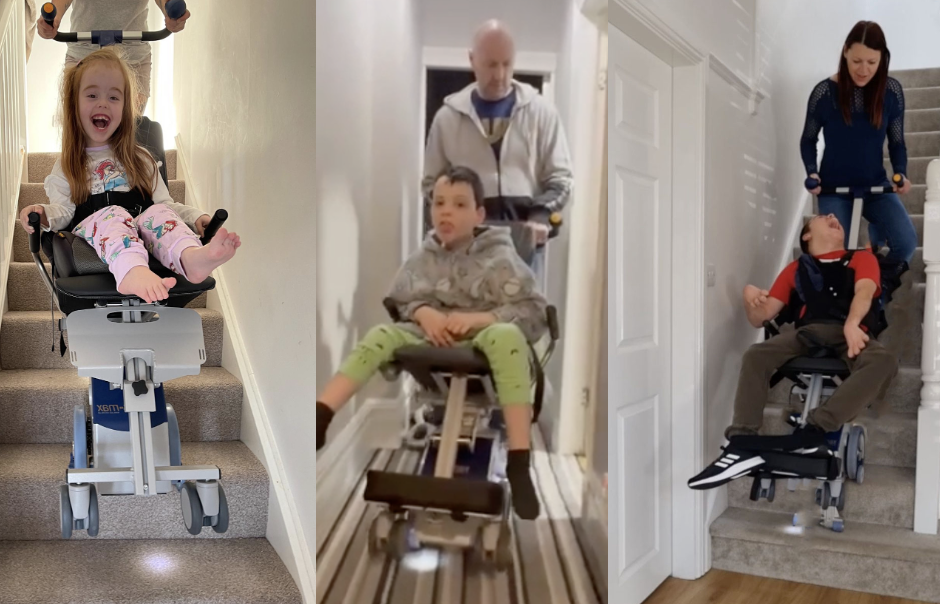
Sella makes stairway navigation safe for child and carer(s).
The child can move around their home securely and comfortably.
Their carer operates and has complete control of the transfer process, making stair navigation safer for them too.
Being a portable unit, Sella carries the child from the stairway on to destination.
The child is protected from the risk of a transfer at the top of the stairs, as would be inherent with a more expensive installed stairlift.
The stairclimber evolves with the child over time when paired with our unique Universal Seat System.
The seat system incorporates adjustable lateral, hip and head supports.
“Providing a stairclimber where appropriate identifies the risk earlier and prevents a problem from needlessly escalating- key elements of the Independent Review of Childrens Social Care,” says Peter Wingrave, AAT Director.
“Such investment in family help also improves the child’s outcome and can reduce spending later on.
"we have numerous instances where our Sella has been provided as the short-term solution to manage risk, but the family has insisted on keeping it, even when a more long-term (and often more expensive) option is available!”
Detail of how the Sella stairclimbing wheelchair works, and AAT’s re-issue package, can be found at
www.aatgb.com/s-max-sella/ and at http://www.aatgb.com/ots/.
We are already ahead of the game, with the development of our innovative re-issue package.
Our re-issue package centres around our top-selling S-Max Sella stairclimber (stairclimbing wheelchair), supported by an efficient assessment programme executed by our team to ensure that not only is the home environment suitable for the equipment, but the clients involved are confident with its use, and the care giver(s) fully trained in its safe operation.
We endeavour to deliver a 10-day turnaround from initial inquiry to fulfilment(3).
The versatility of the Sella unit- with its height adjustability to suit the operator, raft of accessories to ensure the passenger is safe and supported irrespective of their size and capability and portability- means one unit can be prescribed to meet the needs of numerous different clients over its lifespan.
Because the Sella is a mobile, portable device, there is none of the delay inherent in equipment fixed to the structure of the home, nor cost of making good when no longer required.
It offers best value in that stair safety is achieved for <£650/annum(4), whether as short-term risk management until a larger, permanent adaptation is delivered, or as a long-term solution.
And scores of DFG professionals across the country are already appreciating the versatility of the offering, using it to achieve fast risk management of clients needing help with stairs- the first change required to a home(2).
“Many local authorities are increasing their stockholding of our Sella stairclimbers as an efficient way of fulfilling the four pathways proposed by Foundations- triaging cases by complexity, tailoring for people and homes, using resources smartly and letting technology support,” says Peter Wingrave, AAT Director. “Our re-issue programme is unique for OTs and adaptations professionals to effect a fast, efficient and safe solution for stairs. Its growing take-up is proving its versatility and practicality to make homes safe for people with mobility issues.”
Full details of AAT’s re-issue package can be found here:
https://www.aatgb.com/take-steps-to-deliver-adaptations-for-under-1000/ .
ENDS
References:
(2)https://www.nhs.uk/conditions/social-care-and-support-guide/care-services-equipment-and-care-homes/home-adaptations/
(3)subject to equipment availability and T&Cs
(4)Sella purchase price £4650, re-issue x 3 @ £995/ re-issue= £2985/12 years (lifespan of. Sella) = £636/annum
One of the four fundamental words governing adaptations is “appropriate”. The stairs are potentially one of the most dangerous areas of a home, so due diligence must be applied when prescribing any equipment for use thereon.
AAT GB, the UK’s largest and only nationwide supplier of stairclimbers (stairclimbing wheelchairs) is advising OTs to check that their suppliers are as professional and concerned for the client as they are when choosing any method of enabling a disabled person to transfer between floor levels.
That includes the suitability of the equipment for each combination of client and home environment.
It goes beyond: the support given to the client by the supplier- the setting up of the equipment to suit them, explaining/training them in its correct operation so they are comfortable using it, and its service/maintenance.

"Failure to provide appropriate equipment and support has consequences.
“We have become aware in recent weeks of several situations where stairway access solutions have been sold without due care being exercised, where the kit is either inappropriate for the circumstances and client, or its use has not been properly explained to the client. In one case, an elderly lady was just sent the product alongside a video on how to use it. We know of another where the lady was too small to safely get on and off the stairlift even on its lowest setting: she was literally having to almost jump on and off at the top of the stairs!
“It’s people’s safety and independence we are talking about. OT’s need suppliers who exercise the same level of professionalism as they do. It should never be about getting the sale. It’s about the complete service- before, during and after the equipment has been provided.’”
Peter Wingrave, AAT Director
AAT was the UK’s first provider of stairclimbers; 20+ years on it has more than 3500 in daily use up and down the country.
It is the only nationwide supplier that as standard assesses each potential client and their staircase to ensure its relevance, then re-visits the client to set up the stairclimber to their personal preferences/needs, explain how it works, and in advance train them (free of charge) in its safe use- however long it takes.
It is also the only nationwide supplier to have a team of in-house trainers and engineers as large as its sales team, so it can deliver a holistic service that ensures every client is fully confident in the kit.
Full details of AAT’s offering for OTs can be found here: https://www.aatgb.com/ots/.
Caring for elderly parents poses many things to think about. More often than not, reduced mobility and/or falls(2) are the reason(s) why you think about it for your ageing parents.
Did you know the staircase is usually the biggest obstacle: it’s scary to realise that 43,000 people each year are hospitalised as a result of a fall on stairs(3).
You are worried how they are coping at home. You probably have a busy household and are worried about the impact of making your home safe for your parent(s)will have on the rest of the family.
But you can make it safe…
Ideally, you want your parents to stay in their own home for as long as possible. When their mobility- and stability- means that is no longer safe, how easy is it to adapt your home so they can live with you?
The obvious solution is to install a stairlift but that impinges on the stairway and therefore stair safety for their partner in their home, and the rest of the family in yours.
It has to be physically fitted to the structure, be it the wall- assuming that is strong enough to bear the load- or the floor.
Either way, there is the cost and disruption of “making good” when it is no longer needed. If they or you live in a town house, then you need two! Twice the cost, twice the disruption, twice the impact on everyone else…
You could fit a through-floor lift- if there is the layout and space up and down stairs to accommodate it. If they or you live in a town house, then you need two.
Again, there is the cost and disruption of “making good” when it is no longer needed.
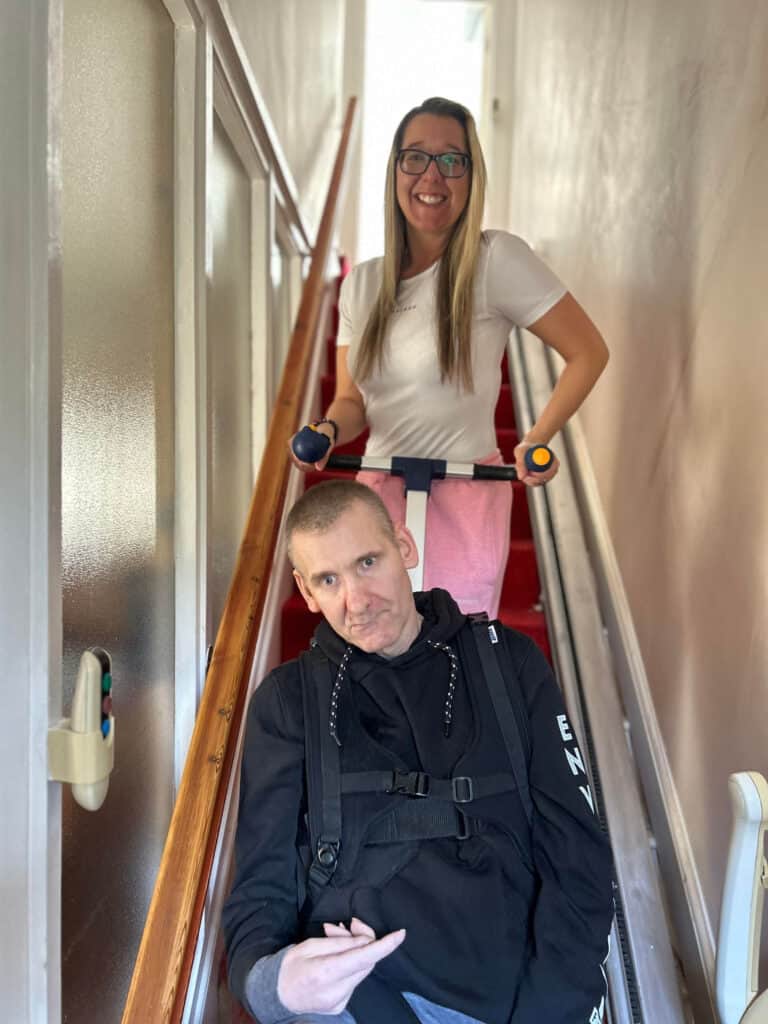
The S-Max stairclimber could be your answer, for both their own home or if they’re moving in with you.
S-Max is a proven solution. The German-engineered device has an impeccable safety record built up over 20 years, with thousands now in daily use across Britain.
The portable, battery-powered S-Max can either be fitted to a wheelchair or have an integral seat (S-Max Sella). Easy to use (with appropriate training), even the most petite person can safely transfer their elderly parent up, down stairs, with each charge of the battery delivering 300 steps.
Our S-Max is fully adjustable to suit each operator and passenger. It makes caring for elderly parents in your - or their- home easier.
The high centre of gravity optimises stability, requiring only a slight tilt of the machine by the operator. Lightweight, it is easy to steer, even round turns on the staircase. A range of accessories ensures your elderly parent is safe and secure.
The rate of climb/descent is fully controllable. S-Max’s unique ComfortStep delivers a smooth, comfortable climb or descent, automatically adjusting to variation in riser height and gently braking on the edge of each riser to facilitate the process for the operator.
Unlike a stairlift, you then have the freedom- and safety- to continue the journey onwards (to bathroom, bedroom, lounge, kitchen, into the garden) without the need for a potentially dangerous transfer off at the top or bottom of the stairs.
When you reach “destination”, the S-Max can be set on its slowest setting to raise up and assist the transfer from S-Max to chair or standing.
It can be stowed away when not in use, optimising living space within the home and, imprtatly, leaving the staircase clear and unobstructed.
It folds small enough to pop into a car boot, so can travel with you to visit other members of the family, trips out, holidays without compromise on where to go because of steps and stairs.
All for less than a month’s stay in a care home. Depending on your circumstances, you may be able to get one free via your local social services.
Hayley Thomson-Kail has an S-Max Sella from her council for her father who has Huntington’s Disease:
“We all think it is brilliant! We were a bit wary at first, but once we were shown how to use it, and adjust the speed to suit what we are comfortable with, we all love it, even Dad. With the various harness straps, we know Dad is safe during the transfer, with no risk of him catching his legs even in chorea. I can’t imagine life without it.”
Phil Sanderson bought one to enable him and his wife Mel to stay in their three-storey home when Mel lost her mobility.
“It really is a fantastic piece of kit,” says Phil.“Before we got the S-Max, we were basically trapped in the basement. Once trained it is very simple to use. Now we can go out for leisure and appointments after months of being stuck inside. It even means we can have family occasions upstairs as we used to, with ease!
“I would recommend the S-Max for anyone who needs help getting up and down stairs.”
As the exclusive supplier of S-Max, we support you all the way, with free, no obligation assessments, full training, and optional service & maintenance via its national network of assessment professionals. Caring for elderly parents becomes less of a worry.
Find out more here: https://www.aatgb.com/s-max-sella/ or call 01978 821875, email sales@aatgb.com.
References:

Now, more than 50% of tenants have a long term illness and impairment with a similar number who need an adaptation not having it(2)..
The most common reported impairments affect mobility, lifting or carrying.(3).
AAT’s top-selling and Class 1 Medical Device certified S-Max stairclimber (stair climbing wheelchair) delivers an almost immediate way to enable a tenant with reduced mobility- whether a short- or long-term limitation- to safely transfer up, down almost any stairs or steps.
Thus, every home be it flat (some 20% of housing stock) or house, can become accessible without impact on common parts.
The battery-powered, German-engineered unit is available in two versions, one which fixes to a wheelchair, one with an integral seat.
Operated by the carer, the mobile unit safely moves its passenger up, down stairs and onward. It is not fixed in any way to the building fabric.
Thus it optimises risk management by reducing or eliminating transfers at the top of stairs, and eliminates impairment of the stairway for other users.
The portability of the S-Max also means there is no delay for DFG funding, survey nor installation. A safe solution for the tenant can be effected within days.
AAT’s assessment managers will support the Association in the specification, train the care giver in the machine’ safe operation (to LOLER criteria.
The company further offers service & maintenance of the unit. To help housing managers understand the relevance of a stairclimber, AAT also provides free demonstrations, and can train designated team members in on-going safe tenant assessment.
When the S-Max is no longer needed by the original recipient, it can be re-allocated to another tenant.

“The core criterium of the most basic level of accessible homes (Category 1, Building Regulations Approved Document M) is that ‘reasonable provision should be made for people to gain access to, and use, the dwelling and its facilities.
"Our S-Max stairclimber offers a best value solution to compliance with the reassurance of an impeccable safety record built up over 20 years.”
Peter Wingrave AAT Director
Full details of the S-Max stairclimber can be found at https://www.aatgb.com/s-max/, where a free, no obligation assessment can also be booked.
References:
AAT’s top-selling battery-powered, mobile Class 1 Medical device the S-Max stairclimber/ stairclimbing wheelchair requires no installation or structural fixing nor modification.
Thus- as specified in the DFG Guidance section 2.30(1)- its provision can be covered by minor adaptations from social services. The time and delay involved in applying for Disabled Facilities Grant funding is eliminated.
The S-Max expediates a person-centred approach, enabling the client to remain at home without disruption to daily/family life.
Prescribing an AAT S-Max potentially expediates a dual-purpose safe transfer/fall prevention option.
The solution has even better use of budgets: with thousands already sold to local authorities over the past 20 years, there may be one already in Community Equipment Stores. This can be re-issued within days.
The battery-powered S-Max smoothly and kinematically ascends and descends steps and stairs. It can be fitted to a wheelchair or be supplied with an integral seat (the S-Max Sella).
It can handle most staircase designs, and complete 300 steps from a single charge. The rate of ascent/descent is set by the operator (care giver), via AAT’s innovative ComfortStep technology, including an energy stop function.
A range of accessories, including AAT’s pioneering Universal Back, means the S-Max can be configured for almost every client from small infant to obese adult with due care and support for their particular physical or mental disability.
The unit itself has full adjustability so it can be quickly set up to exactly suit each operator, making it particularly suitable for clients with several members in the care team.
Full details of the S-Max, and the tool to book a free no obligation assessment ca be found on AAT’s website @https://www.aatgb.com/mobility-stairclimbers/.
(1) https://www.gov.uk/government/publications/disabled-facilities-grant-dfg-delivery-guidance-for-local-authorities-in-england/disabled-facilities-grant-dfg-delivery-guidance-for-local-authorities-in-england
Introducing a new way to support adaptation delivery teams to cut delay in adaptations- to a matter of days!

It is achieved by prescription, where appropriate, an AAT S-Max stairclimber with Universal Back.
The Class I Medical Device certified stairclimber manages the risk of navigating stairs, without the delay and disruption of installing a stairlift, through-floor lift.
The addition of the Universal Back to the S-Max Sella stairclimber means each “passenger” is correctly positioned and secure during the transfer process. The Universal Back can easily adapt to their requirements as their condition changes.
And it can adjust to another user in the future.
That result is achievable in a matter of days: the combination of S-Max and Universal Back can be delivered to the client within a working week of receipt of order.
The speed of delivery is complimented by AAT’s assessment managers, who endeavour to be with the client, and undertake the free, no obligation assessment, within 10 working days.
“Someone’s ability to navigate stairs in one of the most common issues requiring an adaptation or delaying hospital discharge,” observes Peter Wingrave, AAT Director. “Our S-Max/Universal Back combo is, where appropriate, a viable, practical solution.
“It can be delivered within a working week of order, with full training given.
"It requires no structural alteration to the home, nor installation.
"If/when no longer needed, it can be taken into stores and re-issued- expediating another adaptation without the need for grant funding.
" It can help prevent future admission/re-admission, by reducing the risk of a fall on the stairs- one of the top home hazards.
“With the current, and ongoing pressure on NHS and social care services, surely it makes sense, where reasonable and practical, to make use of such resources?”
Further details of the AAT S-Max and Universal Back can be found here:
Further details can be found here:
https://www.aatgb.com/s-max/,
or by emailing sales@aatgb.com, calling 01978 821875.

Government figures show that 45% of patients to be discharged need up to six weeks’ recovery support from health & social services.
AAT GB has responded to the need, and NHS/social care budgetary constraints, with stockholding and a hire facility for its range of stairclimbers.
Under the package, a stairclimber can be provided, with appropriate training, for as short a duration as a week.
This enables the patient to be transferred throughout their home without the need to re-arrange the whole house to provide, for example, a downstairs bed. It can eliminate discharge delay.
“One of the biggest problems in getting people home, safely, is the suitability of their home if they have reduced mobility. They may need a wheelchair some or all of the time.
"How do they then access their bedroom, bathroom? The traditional route is to delay whilst an adaptation is provided.
“Taking an innovative approach- providing a stairclimber- delivers a best value solution. It allows the person to be discharged within days.
"It gives them a safe, appropriate means of accessing all floors of their home, on the proviso there is someone else at home to assist. A significant proportion of people only need that help for the short term, so hiring is a fast, efficient answer.”
Peter Wingrave, AAT Director
German-engineered AAT stairclimbers offer the greatest flexibility on the market, accommodating all shapes and sizes, from paediatric to morbidly obese (230kg) passengers.
They are Class 1 Medical Device certified.
They can accommodate narrow and even spiral flights of stairs.
Options feature an integral seat eliminating the need for a wheelchair indoors, or the unit can clip-fix to a wheelchair if preferred.
Most local authorities already have AAT stairclimbers in their equipment stores which can be endlessly re-issued when no longer needed by an individual.
However, with the increased demand, stock may not be available. As part of its package, AAT can deliver an S-Max within 3 days of receipt of order. Or the Authority/Trust can hire one, for as little as a week. Whichever option, AAT' team personally set up the stairclimber for each user, and train the caregiver(s) in safe (LOLER compliant) operation.
Find out more: https://www.aatgb.com/hire-rental/ or by telephoning 01978 821875, or visiting www.aatgb.com and using the Live Chat facility at the bottom of the home page.
Anyone involved in delivery of home adaptations knows too well how beset with pressure their work life is.
The backlog of assessments amplified by Covid, the whole adaptations/Disabled Facilities Grant (DFG) process, minimising hospital admissions and accelerating hospital discharge are just some of the contributory factors.
Part of the problem lies in that, with the morass of boxes to tick in terms of paperwork, we sometimes forget the underlying ethos of DFG.
It is to make life better for the person, to enable them to live as independently as possible in their home environment for as long as reasonably practicable.
It is PERSON centred. That includes the impact of any adaptation on the rest of the household.
There is a ground swell of new options that can alleviate the pressure. The opportunity now exists requiring a combined team approach, where everyone within the Better Care Fund administrative structure- especially the Local Authority, NHS Trusts and Clinical Commissioning Groups- can make a conscious review of the way they work.
Key tools to utilise are:
The Guidance(1) has simplified the adaptations process in that it breaks it down into four elements under which a Grant can be given. It optimises discretionary powers (Regulatory Reform Orders aka RROs). It provides guidance on how to prioritise delivery.
To give an example, a parent is struggling to carry their growing disabled child up the stairs. The child cannot walk upstairs unaided.
The issue has a substantial effect on their daily life: adaptation is necessary, appropriate, reasonable and practicable. Under section B68 of the Guidance, the urgent works i.e to reduce the significant risk to parent and child should be addressed first to avoid delay.
The Tool takes what is widely practised in A&E departments and applies it to adaptations.
It breaks the initial client contact down into four key questions, with a “traffic light” system as to whether any third party assessment is needed.
It is worth remembering that although the client may need an OT or similar assessment because the need is complex, the solution may not be!
To reiterate our example of the parent struggling to carry their growing disabled child up the stairs, the child cannot walk upstairs unaided therefore a carer is needed. Under the Triage Tool an OT/Trusted Assessor is required.
Yet the solution could be as simple as provision of a stairclimber- something that may well be available in equipment stores, that does not require a surveyor to assess the physical fabric of the home as there are no building works/ structural fixings, alterations, something that is comparatively low cost if purchase is required so could be done under an RRO.

It is increasingly accepted that manufacturers can play a vital role in accelerating delivery of adaptations. Indeed, many Local Authorities are as a matter of course now involving manufacturers in the assessment process whether via a formal tender agreement or more informal called in as required…
It makes sense to do so.
Manufacturers are experts in their particular area and can support and advise the OT in the daily living practicalities of the client and their home environment, clinical assessment and Grant application process.

Stairclimbers(2) are mobile units that safely transfer the client up and down stairs.
They provide a swiftly available, low cost alternative to the accepted inter-floor transfer methods (stairlift, through-floor lift) as they can be delivered within days with no need to install or undertake any structural alteration. If nothing else, they can provide an expedient short-term solution to minimise risk but are often chosen by clients as a permanent solution(3).
They have an unrivalled safety record. They minimise risk in the potentially dangerous process of getting up and down stairs. They minimise transfers. They require no installation or physical alteration to the home. They do not impede other members of the household’s use of the home. They eliminate the need to re-arrange the home, moving beds downstairs etc. Should the client move house, the stairclimber can easily be transferred alongside. They enable the client to go beyond their home, into the garden or down front steps into their community. They can be re-issued to other clients when no longer needed by the initial recipient.
At AAT we will- free of charge and obligation- assess the client either alongside or in place of the OT (within 10 working days of contact), prepare a detailed report including photographs for the OT to integrate into the submission to the grants officer, supply the stairclimber to the client, set it up to their precise needs, and train the caregiver in its use. We can revisit to adjust over the years as the client’s needs change. We can service the machine on an annual basis.
We are already successfully providing this service throughout the UK mainland with individual within RROs
Click the link to book your free, no obligation assessment now: https://www.aatgb.com/mobility-stairclimbers/
references:


