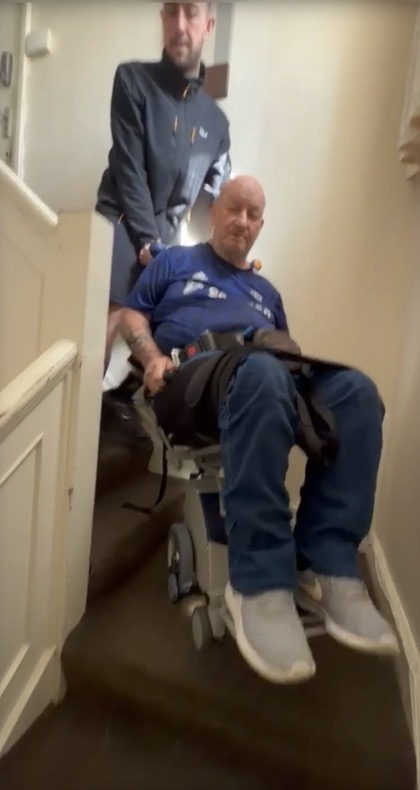
Licensee Robert Atkinson was left paralysed from the waist down and confined to the flat above his pub after a freak accident on holiday.
Now he can join in with the locals again- thanks to our S-Max Sella mobility stairclimbing wheelchair.
S-Max Sella- provided by York City Council- means Bob now saefly and easily navigates the complex staircase connecting flat and pub.
He negotiates the stairway and its two half-landings.
He's back into the social space downstairs, with a little help from his family to steer the stairclimber.
Bob’s Occupational Therapist realised how important for his mental health it was to give Bob the opportunity to get out of the flat and back into the pub environment.
However, she couldn’t use conventional solutions such as a stairlift or through-floor lift because of the stairway design. It has two half landings and two turns- one 180 degrees!
Our S-Max Sella mobility stairclimber could solve navigation along the whole staircase.
We carefully assessed the staircase, Bob and his family and showed that the Sella WOULD work.
We trained Bob's family.
They are happy transferring him into the stairclimber’s integral seat and operating the device.
Bob explains, “I’ve been licensee at The King William for 18 years; a year ago I tripped on holiday and shattered vertebrae in my back. I can’t walk, and have to be hoisted out of bed, or wherever I am sitting.
"It changed my life, and has impacted not just my mental health, but the family too.
“The stairclimber’s been a Godsend.
" I’m not confined to the same four walls anymore! I can chat with my friends, have a game of dominoes. We could have our traditional big Christmas get-together in the pub!”

You can find full details of Sella, including videos of the device in action, examples of how it has helped numerous people with impaired mobility and how to book a free, no obligation assessment, here @
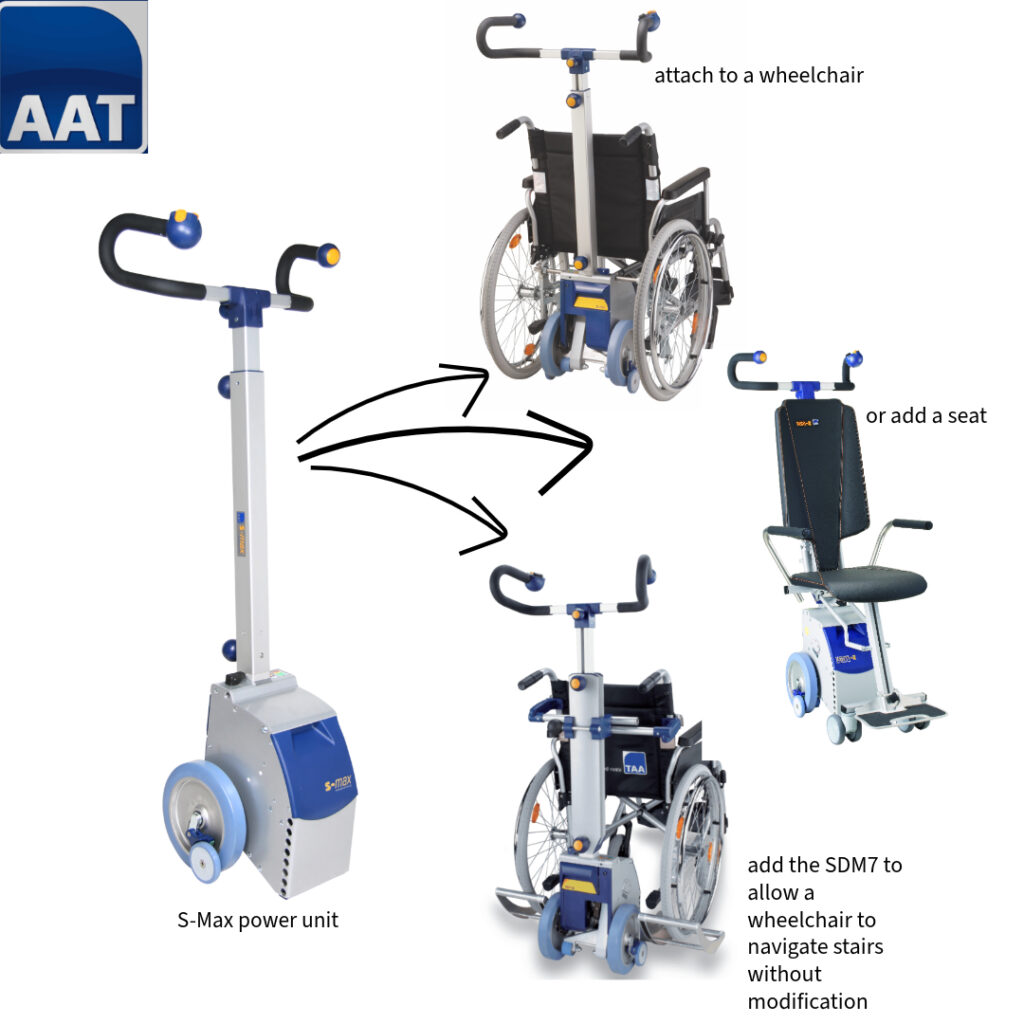
Applying the concept of one power pack for numerous tools, our S-Max makes stairs safe for wheelchair users and anyone else whose mobility is impaired.
Attach our core S-Max power unit to most standard manual wheelchairs. You turn it into a stairclimbing wheelchair.
Add our seat to the S-Max and it deals with more ambulant people who can’t manage stairs on their own. You make stairs safe for them too.
Add our Universal Seat System- developed with OTs- and in one accessory you address almost every additional support and stability required. So even someone with complex disabilities finds stairs safe again.
When prescribing, you can mix and match the three core components to suit almost every person who needs help with stairs, and who has a competent carer.
The components adapt from infants to tall elderly, initially and as their requirements change over time.
So whether your disabled client is a child, adult or elderly, you have the power to make stairs safe, quickly and easily.
The system’s flexibility means that once the original recipient no longer needs the equipment, we can be cost-effectively adjust and set up for someone else.
Says Gareth Brown, AAT Technical Director:
“More and more Occupational Therapists are appreciating that our top-selling S-Max Sella stairclimbing wheelchair can be re-issued time and again to support clients.
“Indeed, some local authorities now buy a stock of them for that very reason.
“But few appreciate that the power behind Sella- the S-Max- can be adapted so easily and efficiently to give them even greater scope.
"We bring them fast risk management.
"We enable them to re-use equipment that is reasonable and practical to purchase with none of the delaying considerations.
You remove the problems and cost of funding, installation, inability to re-prescribe, making good- inherent with the conventional, fixed alternatives.”
When you provide S-Max, you do more than just enable an elderly or disabled person to get up and down stairs.
You enable them, and their family, to retain normality and routine to daily life. So you improve mental health & wellbeing for all.
Further, because your client can still access their bedroom, the bathroom, you maintain their privacy and dignity , and family life.
A stairclimber is also safer for them and their carer(s): the risks involved in carrying them upstairs are removed.
You also remove the need to transfer at the top of the stairs- inevitable with a stairlift.
Today, our S-Max is the top-selling mobility stairclimbing wheelchair in the UK.
Almost every local authority and NHS Trust has it.
S-Max has an unrivalled safety record spanning 25 years.
S-Max is unique in its product sector.
And we have a nationwide team to support you in client assessment and prescription.
We provide in-person setting up, servicing of the equipment and training the carer in its safe operation.
Full details of our S-Max can be found @ www.aatgb.com/s-max/ whilst details of its re-issue capability are explained @ www.aatgb.com/ots/.
Note S-Max can be attached to most common manual wheelchairs. The stand-alone unit can navigate most common stairway designs but will need the wheelchair wheels to be removed.
If the staircase is wide enough, addition of the Universal Rack to the S-Max power unit means the wheelchair can be moved up and down stairs without modification.
The equipment is our Sella mobility stairclimber, prescribed through the Occupational Therapy service at Ainsdale Centre for Health & Wellbeing.

Dad Paul says that our Sella has made a massive difference to family life normality: Isaac can have a bath again, sleep in his own bed in the room he shares with his brother, and they have space and freedom to be a family downstairs.
Isaac , 9, was born with Cerebral Palsy and has dystonia. A mistake during brain surgery meant to improve his quality of life made Isaac’s condition worse: he became less able and heavier.
Paul and his wife Rachel were struggling to carry Isaac up and down the steep stairs in their Victorian home.
The only answer for everyone’s safety until a solution was found was to move Isaac’s hospital bed into the front room.
The family’s Occupational Therapist Helen Murphy appreciated the family’s desire for Isaac to be able to access upstairs, to be in his own bedroom and be able to bath.
So she reached out to us to assess Isaac, the family and the home environment to determine whether our Sella mobility stairclimber would be appropriate.
Sella worked! Paul and Rachel found it easy to transport Isaac up, down the stairs and on to their final destination- the bathroom, bedroom, lounge, with no need to lift/transfer Isaac en-route…
Sella is the UK’s top-selling mobility stairclimbing wheelchair. Its light weight, high balance point and automatic braking make it easy for Paul and Rachel to use.
Sella’s in-built seat, arms and lap belt mean Isaac is always safe and comfortable, even if he has a dystonic episode whilst on the stairs.
For the family, it was an added bonus that AAT made the effort to deliver the Sella the week before Christmas.
“It made such a difference to our Christmas celebrations!” says Paul. “Isaac could be with his siblings upstairs and have a stocking at the end of his bed on Christmas morning. We were able to celebrate as a family, with space, in the front room.”
Adds Paul: “We know life will never be ‘normal’, but we want Isaac to do as much as he can. Little things like being able to have a bath, which he loves, and to be with his brother and sister upstairs make all the difference. Now he can do those things again, because we can safely get him up and down stairs with the stairclimber.
“And hopefully, in the summer, we can use it to get him out into the back garden too!”
Full details of the Sella stairclimbing wheelchair, how it works and how to book a free no obligation assessment can be found @ www.aatgb.com/s-max-sella/.
It's even the advice of the Chief Medical Officer(1). Prescription and implementation of straightforward, compact equipment to enable older people to access their homes safely and remain independent is crucial.
Almost all older people in England (96%) over the age of 55 live in mainstream housing, but that housing often has small room sizes, steep internal stairs, and steps outside.
Most of the houses we will occupy in 2050 are already built, highlighting the need to address existing stock(2).
Stairs are the second biggest hazard in our homes, accounting for 1million+ accidents/annum(3). Ability to move around our home affects our wellbeing(2)..
A stairclimber or stairclimbing wheelchair (AAT’s S-Max) typifies the type of straightforward equipment that can help rectify the access problem.
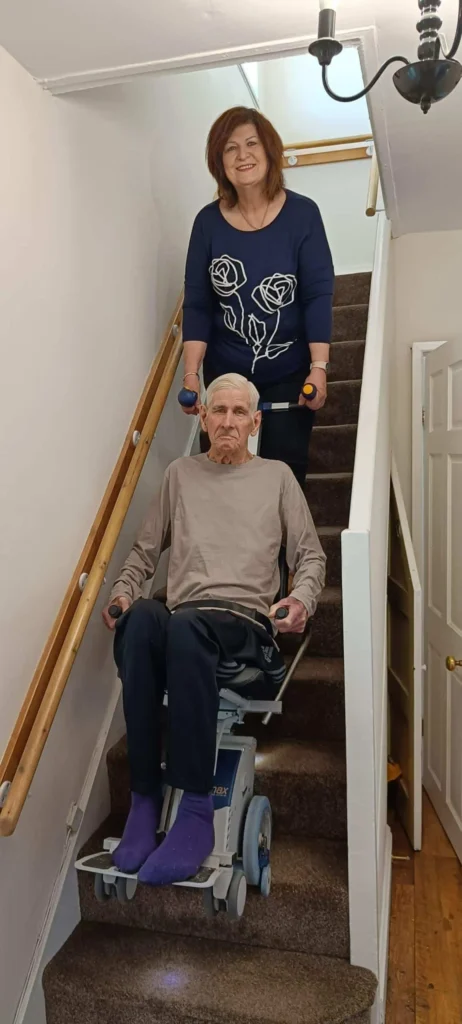
It can be attached to most wheelchairs, or supplied with an integral seat. Te stairclimber moves at a rate determined by the operator. It makes dealing with steps and stairs safe and secure.
The Class 1 Medical Device certified battery-powered kinematic S-Max stairclimbing wheelchair is portable and mobile.
S-Max requires no installation, no need for a structural survey or building works. This means it can make home access safe within a matter of days.
Further, it means the person does not need to transfer at the top or bottom of the stairs or steps, but can remain safe in the S-Max to wherever they need, want to go.
Says Peter Wingrave, AAT Director. “S-Max’s relevance as a piece of equipment to help elderly people remain safe and independent in their homes is proven. With the growing crisis in social care and the NHS, use of S-Max could help reduce both admissions and delays in discharge and empower our ageing society to remain in their homes.”
Full details of S-Max, including how it works video, technical details including the range of accessories available, case studies and testimonials from real-life users, can be found at www.aatgb.com/s-max.
ENDS
references
(1) https://assets.publishing.service.gov.uk/media/65562fcfd03a8d000d07faa4/chief-medical-officers-annual-report-2023-executive-summary-web-accessible.pdf
(2) https://ageing-better.org.uk/resources/role-home-adaptations-improving-later-life
Already, almost 1million people have dementia. Half of the UK population will be dealing with dementia in our lifetime(1).
Only 7% of our homes have key accessibility features such as a ground floor WC.
Dealing with dementia and its impact mobility and movement means that even something as mundane as going up, down stairs- to bed, to bath, to use the toilet- becomes difficult.
It can even be potentially dangerous.

You can manage the risk, quickly and easily.
And you can do it without any of the delay usual with a home adaptation, and without impacting on how others in the household can use the stairs.
Our S-Max Sella stairclimber/ stairclimbing wheelchair is a portable, mobile unit that folds compactly away when not in use.
Class 1 Medical Device certified, Sella provides a proven, safe, supported way for you, the carer, to take the dementia patient up and down stairs- and beyond.
Familiar routines can be preserved. Mobility and movement around the home is restored.
You don't need to transfer your loved one from the Sella at the top or bottom of the stairs. Sella continues the journey onwards to whichever room, further improving safety.
Sella is battery-operated. Each charge delivers sufficient power to undertake 300 steps. You have complete control over the speed.
You can pause the step process en route. Sella automatically smoothly brakes at the top of each riser to maintain complete operator control.
We support your Occupational Therapist in assessment of the home environment, dementia sufferer and their carers to ensure all are comfortable with the kit.
We also set up the Sella to suit each person involved and train you in how to use it.
Julie Murray was given a Sella to help her with her husband Robert who has dementia.
Their OT realised the only way the family could get Robert up, down stairs to bed and bathroom was on son Harry’s back!
Julie says, “The Sella has changed our lives! It’s made daily life so much safer. It has meant I can keep Robert’s routine, life, as normal as possible, getting him up to bed.
"With only having one toilet at the time, upstairs, the Sella meant I can get him there in time.
"And even with a wetroom downstairs now, the Sella is still in daily use, getting Robert up in the morning and to bed at night.”
Full details of Sella, including how to book a free, no obligation assessment, can be found here:
https://www.aatgb.com/s-max-sella/.
(reference: (1)https://dementiastatistics.org/about-dementia/prevalence-and-incidence/)
You may also be interested in:
https://www.aatgb.com/deal-with-steps-and-stairs
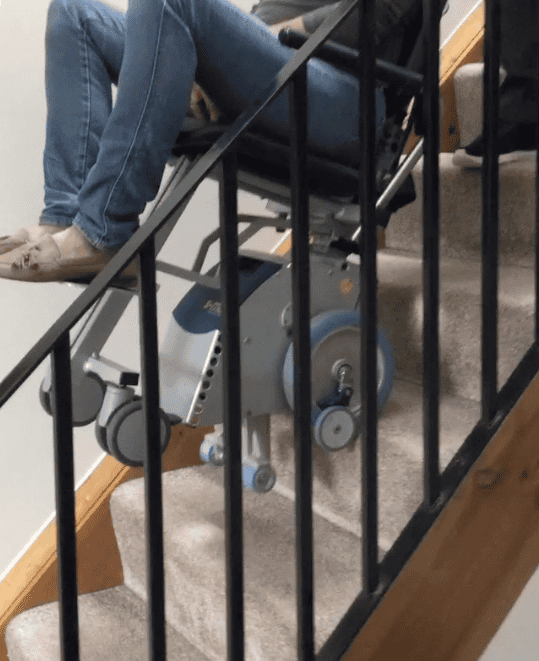
Where relevant, changing the mindset from providing a person to providing equipment that does not need Disabled Facilities Grant (DFG) funding could radically reduce the number of people waiting for care support. It could cut the cost of care.
With the continuing lack of staff, people in need are left struggling to live daily life with any degree of quality.
As importantly, the staff themselves are exposed to greater risk as their workload increases.
Unpaid carers too are being put at risk by having to manage without support.
By using the right equipment- where relevant- to reduce the reliance on carers-paid and unpaid- mean that clients would be more independent and have a better quality of life.
Strain would also be reduced on the care workforce, enabling them to deliver better quality of care for those instances where kit is not appropriate.
Using equipment would reduce the risk of unpaid carers injuring themselves lifting, moving, handling. These actions put further strain on the paid care workforce who have to step into the breach.
And it needs to be the right equipment- that achieves the end purpose for the client, safely, and that can be expediated without delay.
Says Peter Wingrave, AAT Director:
“There is a mindset within social care that if someone is struggling with stairs, then you put in a stairlift (or a through-floor lift). Yet that requires DFG funding, which takes months, years to fulfil.
"Inbetweentimes, the client is left with a compromised living space and little or no privacy if a bed has been moved downstairs- assuming that can be done- or their access to areas of their home- bedroom, WC etc- is wholly dependant on the availability of a carer- paid or unpaid- to help. It also puts that care giver at risk.
"“Most local authority equipment stores have at least one stairclimber, that can be delivered to the client, and their caregivers trained on its safe operation, within days.
"Thus the risk to all parties is minimised, fast and cost-effectively. The need to provide paid care is reduced/eliminated.
"As an added bonus, when that client no longer needs it, the stairclimber can be re-prescribed (recycled) to another, achieving best value and best use of resources from every relevant perspective.”
Our mobility stairclimber is battery-powered devices that help people with impairments safely and comfortably navigate stairs with the support of a carer.
Unlike alternative equipment that is fixed to the structure of the home, our stairclimber is portable. So, when no longer needed by the original recipient, someone else can use it.
We offer a free, no obligation assessment service to determine the relevance of its kit for each potential client, including their care-giver and staircase.
We have an unrivalled safety record for its equipment, stretching back over 20 years, with thousands in regular use up and down the country.
Full details are available on our website www.aatgb.com/sella.

Falls and manual handling are among the most common personal injury claims lodged against Councils(2), the bill for which now tops £100m(3).
Minimising risk is therefore a growing priority.
Thus, AAT has developed its recycling (re-issue) package, whereby its stairclimbers already purchased by the Local Authority can be re-allocated and in use within a matter of days.
That the stairclimber can be collected from stores or the previous user and taken direct to the new potential client.
This removes the delay of arranging for the client to travel to a demonstration site for a stairlift or similar device, further accelerates the speed with which the risk is managed.
No other stairway access system can be delivered so cost-effectively, so fast, AAT believes.
AAT’s recycling scheme can be utilised by almost every Local Authority in the UK, as almost all have kit in stock among in its equipment.
“With budgets under so much pressure, every opportunity to make every £ work as hard as possible must be taken,” says Peter Wingrave, AAT Director.
“It’s not just about the money. It is about quality of life- and safety- for the vast number of client awaiting adaptations to their homes.
"It is about supporting OTs and adaptations teams to effect a solution- whether short or long-term- quickly. It is about helping their- and their clients’- mental health & wellbeing.”
Leeds City Council is one Authority already making use of AAT’s recycling scheme, to the extent AAT manages the Councils’ stairclimber stock too.
Says Leeds City Council Occupational Therapy Team Manager Jane Fisher: “Funds and time are under pressure now more than ever. This means we can quickly empower clients to still be able to access all levels of their home, with the peace of mind that the right kit is being supplied, maintained and serviced, and in full working order.”
Full details of AAT’s re-issue facility can be found here:
https://www.aatgb.com/taking-steps-to-reduce-adaptation-delay-for-650-recycle/.
ENDS
References:
(1)https://bregroup.com/press-releases/bre-report-finds-poor-housing-is-costing-nhs-1-4bn-a-year/
(2)https://www.legalexpert.co.uk/top-10-councils-personal-injury-compensation/
(3)https://www.taxpayersalliance.com/bill_for_council_compensation_payments_tops_100_million
The Government’s NHS reset drive to address NHS waiting lists means more has to be done to resolve bed-blocking which now represents the bed capacity of 26 hospitals, a study reveals(1).
According to NHS data(2), dealing with stairs at home is the primary cause of delay in hospital discharge.
We've already put in place an innovative strategy to facilitate a solution: our stairclimber re-issue capability provides a safe and cost-efficient answer, that can be achieved within a matter of days.
When the original recipient no longer needs the stairclimber, it can be re-allocated to someone else, subject to appropriate assessment.
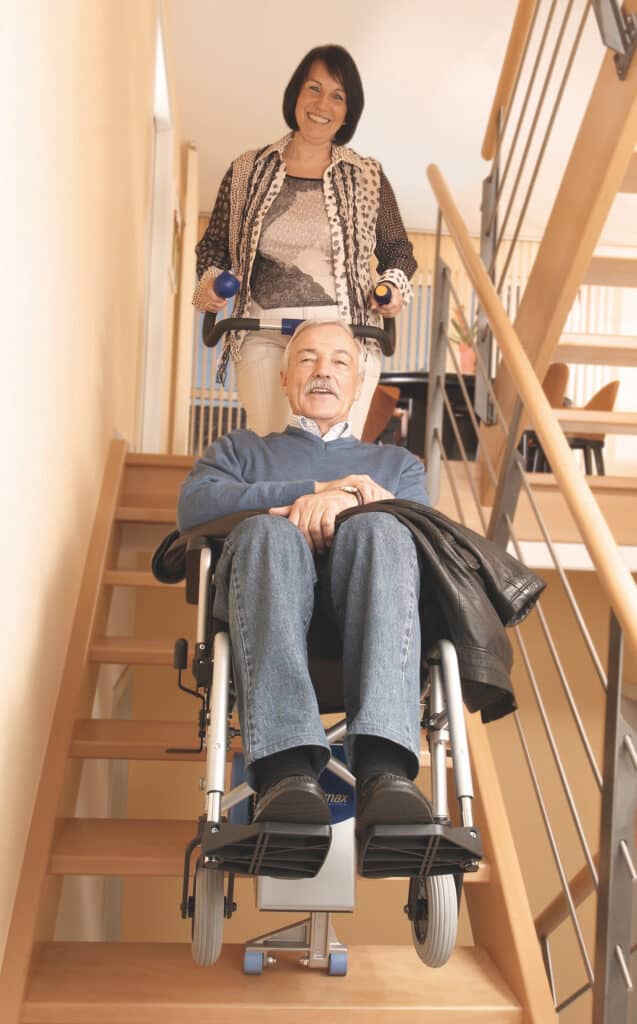
Because the stairclimber is free-standing and portable, there is none of the delay inherent with alternative stairway access methods, which require structural surveys, installation etc.
We are the UK’s largest supplier of stairclimbers to the NHS and local authorities, with thousands of units already ‘on the books’ within the health and social care sector.
And we have developed a unique Universal Seating System that ensures almost every user- young or old- can be safely and corrected supported when using the stairclimber without the need to purchase additional accessories.

Thus we're the only company currently capable of expediting such a rapid best value solution.
“We welcome the Government’s commitment to resolving hospital waiting lists,” says Peter Wingrave AAT Director.
“But it is obvious that, in order to get more people through the hospital system, beds need to be freed up. Anything that can be done to support that surely must be given serious consideration.”
Full details of our re-issue package can be found here:
https://www.aatgb.com/take-steps-to-deliver-adaptations-for-under-650/ .
References:
(2)https://www.nhs.uk/conditions/social-care-and-support-guide/care-services-equipment-and-care-homes/home-adaptations/


The transformation is the outcome of the approach adopted by Torbay and South Devon NHS Foundation Trust Occupational Therapist Andrea Williams, who turned to us.
Now, for the first time in two years, Sarah can not just get out of her bedroom, but outside too!
Andrea realised an S-Max Sella stairclimber could be the solution to stopping Sarah being bed bound.
It would give Sarah the means to safely navigate the staircase with its two turns in the Grade II listed two-storey house.
What's more, it could get her outside too!
When we demonstrated S-Max Sella and how it would work in their home, Sarah and her husband James asked Andrea to prescribe it for them.
Husband James, operates and controls the Sella, after training from us.
He uses the portable, battery-powered Sella to safely transfer Sarah up and down the stairs and on to whichever room she wants to go.
It even steps across the raised threshold of the door to outside and the garden!
“Even getting from her bed to a reclining chair tires Sarah out,” explains James. “With the stairclimber, we only have one transfer.
"One of Sarah’s goals was to spend time outside. She was blown away with the stairclimber: it was the first time in almost two years she had been downstairs, let alone out into the garden!
"The stairclimber’s so versatile, it easily dealt with the lip on the door to the patio.”
Adds Andrea, “Being listed meant it would be difficult to adapt the house to accommodate a stairlift or through-floor lift.
"The effort of transferring from bed to wheelchair to stairlift then off the stairlift would exhaust Sarah.
"A stairlift may have been able to get her up and downstairs, but she’d still be confined to the house.
"I am so pleased it’s made such a difference to them both.”
We are the UK’s leading supplier of stairclimbers, with the Sella being the #1 seller.
Strong yet lightweight and completely portable, Sella features a perfect balance point and PowerStep feature which means the smallest carer can easily operate and control the unit. They can even pause or stop en-route if needed.
When not in use, it folds compactly away.
There's no need for installation, home adaptation nor impingement on the stairway or part of the home for other members of the household
Our range of accessories enable the Sella to accommodate every passenger’s safety and postural support: options address seating and harnessing requirements from head to toe.
More details of AAT’s Sella and range of accessories, plus the ability to book a free, no obligation assessment, can be found here: https://www.aatgb.com/s-max-sella/.
We are seeing a 20+% year on year increase in sales over the past five years.
And we are seeing a growth in re-issue of the equipment to occupational therapy clients beyond the person for whom the equipment was initially purchased.
The upturn is due, we believe, to growing understanding of the role our stairclimbers can play in managing the risk of falls and reduced mobility on stairs. And the speed with which we can deliver, thereby facilitating hospital discharge whether as a short, medium, or long-term solution.
More equipment out there, and more equipment being used, means more equipment needs to be serviced, and more people need to be trained on its use.
“With thousands of S-Max Sella units already in daily use across the country, many of which have been in use for 10 years or more, we believe we have a duty of care to support our clients so that our stairclimbers/ stairclimbing wheelchairs continue to help people return to or remain in their home and for the S-Max Sella to build on its proven, impeccable safety record,” says Peter Wingrave, AAT Director.
“Alongside that, with the continuing increase in sales, we have growing demand for training. We are training OTs in the role stairclimbers can play in empowering people to remain at home and/or to expediate hospital discharge. We are training the care givers in the safe operation of the equipment. And we’re setting up the equipment to the personal needs of each recipient and their carer(s).
“We’re committed to doing it right, and without delay. The only way we can do that is to expand the team to match demand and spend all the time someone needs to ensure they are comfortable prescribing or using S-Max Sella.”
Full details of the S-Max Sella range of stairclimbers- the established #1 stairclimbing wheelchair brand in the UK and the only one supported by truly nationwide sales, service & support- plus how to book a free, no obligation assessment, can be found @ https://www.aatgb.com/s-max-sella/.


