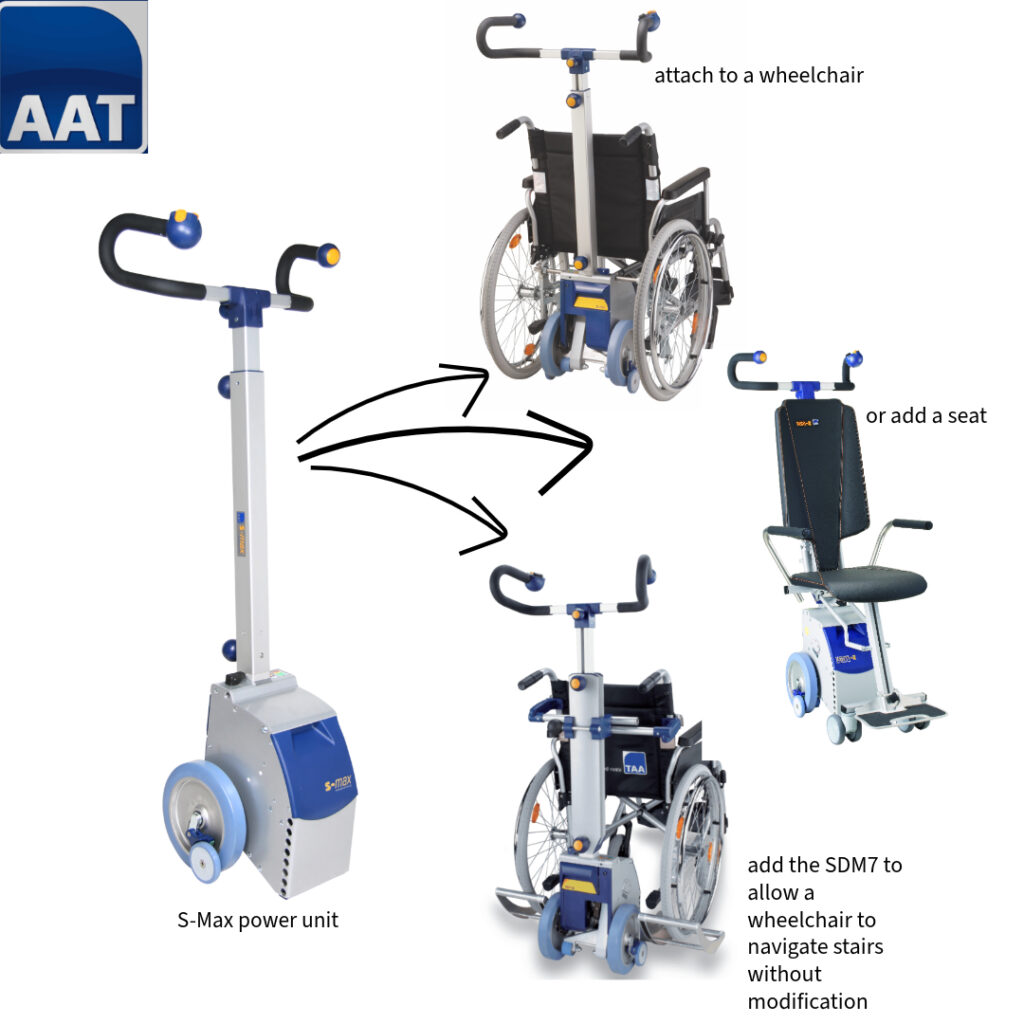
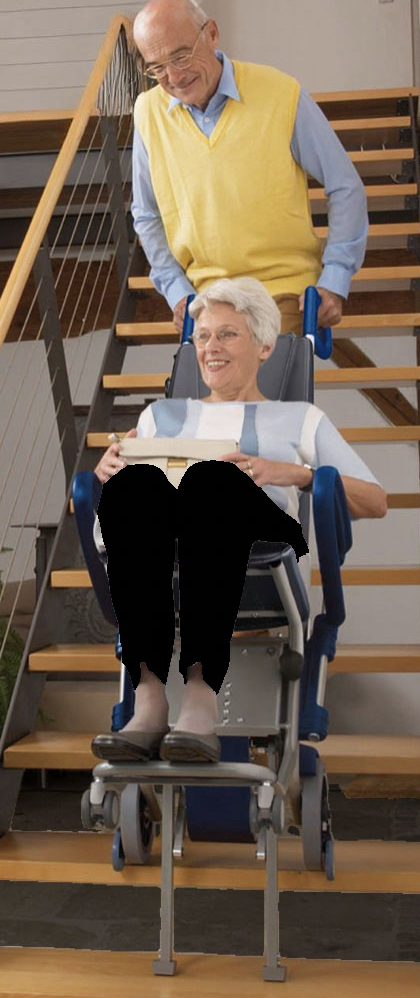
Applying the concept of one power pack for numerous tools, our S-Max makes stairs safe for wheelchair users and anyone else whose mobility is impaired.
Attach our core S-Max power unit to most standard manual wheelchairs. You turn it into a stairclimbing wheelchair.
Add our seat to the S-Max and it deals with more ambulant people who can’t manage stairs on their own. You make stairs safe for them too.
Add our Universal Seat System- developed with OTs- and in one accessory you address almost every additional support and stability required. So even someone with complex disabilities finds stairs safe again.
When prescribing, you can mix and match the three core components to suit almost every person who needs help with stairs, and who has a competent carer.
The components adapt from infants to tall elderly, initially and as their requirements change over time.
So whether your disabled client is a child, adult or elderly, you have the power to make stairs safe, quickly and easily.
The system’s flexibility means that once the original recipient no longer needs the equipment, we can be cost-effectively adjust and set up for someone else.
Says Gareth Brown, AAT Technical Director:
“More and more Occupational Therapists are appreciating that our top-selling S-Max Sella stairclimbing wheelchair can be re-issued time and again to support clients.
“Indeed, some local authorities now buy a stock of them for that very reason.
“But few appreciate that the power behind Sella- the S-Max- can be adapted so easily and efficiently to give them even greater scope.
"We bring them fast risk management.
"We enable them to re-use equipment that is reasonable and practical to purchase with none of the delaying considerations.
You remove the problems and cost of funding, installation, inability to re-prescribe, making good- inherent with the conventional, fixed alternatives.”
When you provide S-Max, you do more than just enable an elderly or disabled person to get up and down stairs.
You enable them, and their family, to retain normality and routine to daily life. So you improve mental health & wellbeing for all.
Further, because your client can still access their bedroom, the bathroom, you maintain their privacy and dignity , and family life.
A stairclimber is also safer for them and their carer(s): the risks involved in carrying them upstairs are removed.
You also remove the need to transfer at the top of the stairs- inevitable with a stairlift.
Today, our S-Max is the top-selling mobility stairclimbing wheelchair in the UK.
Almost every local authority and NHS Trust has it.
S-Max has an unrivalled safety record spanning 25 years.
S-Max is unique in its product sector.
And we have a nationwide team to support you in client assessment and prescription.
We provide in-person setting up, servicing of the equipment and training the carer in its safe operation.
Full details of our S-Max can be found @ www.aatgb.com/s-max/ whilst details of its re-issue capability are explained @ www.aatgb.com/ots/.
Note S-Max can be attached to most common manual wheelchairs. The stand-alone unit can navigate most common stairway designs but will need the wheelchair wheels to be removed.
If the staircase is wide enough, addition of the Universal Rack to the S-Max power unit means the wheelchair can be moved up and down stairs without modification.
Safeguarding also involves empowering children to engage with normal family life and routine.
For any child with reduced mobility, there comes a point where their- and family life- is disrupted, because of a fixture present in almost every home: the stairs.
We, the UK’s biggest provider of stair navigation solutions to local authorities and the NHS, have developed a potential resolution, that prevents any disruption to the home, can remove the need for a major DFG adaptation/modification or re-housing.
We deliver access to the home, retaining routine and normal life.

Our proposal is cost-efficient: the core components not only answer the problem of giving them and their family a safe environment at home, they grow with the child to adulthood.
When the original recipient no longer needs the S-Max, Occupational Therapists can prescribe/recycle/re-issue it to another child. And there's little or no additional capital equipment cost.
Central is our proposition is our top-selling S-Max mobility wheelchair stairclimber. S-Max is a core powerpack unit that can be attached to a wheelchair or have an integral seat.
Add our unique Universal Seat System, which adjusts to individual need, and the child can be safely transported as they develop from infancy into maturity.
The way S-Max works further enables Occupational Therapists to enhance safety at home.
S-Max traverses the stairway and on to destination. S-Max removes the risk of a transfer at the top of the stairs that is inevitable with a stairlift.
Normal family life continues with dignity and privacy.
“Two of the four key aspects of safeguarding children are promoting welfare: ensuring children have the best outcomes and are growing up in safe, effective circumstances and early intervention: supporting children and families when problems emerge to prevent issues from escalating(1).
“Difficulty managing stairs is one of the most common reasons why any family with a disabled member needs intervention and support.
"Where appropriate, our S-Max is a time- and cost-effective means of preserving safety.
"We can support in PEOP assessment, service, deliver the S-Max and train the family in its safe operation within two working weeks. If one is available in Equipment Stores, it can be effected even faster!
“The child is kept safe. Their- and their family’s- wellbeing, mental health, dignity and privacy- is protected.”
Our re-issue scheme, and how the S-Max works, is explained on our website: www.aatgb.com/ots/ and www.aatgb.com/s-max/.
Our offer centres around disabled children, supporting them and their families to remain safe in their existing home.
We can improve outcomes for the children and their families, and reduce spending- even as the child grows into adulthood.
For carers of a child with mobility issues, the usual scenario is that they carry them up and down stairs. As their child grows, or their condition(s) worsen, that scenario puts the child and their carers at risk, of falling down the stairs, and injury to one or all involved.
For children's social care teams, managing that risk usually involves a significant home adaptation, funded via the Disabled Facilities Grant (DFG).
That takes time- assuming a suitable adaptation can be implemented.
Provision of our S-Max mobility stairclimbing wheelchair is a “quick fix”.
Most local authorities already have the Class 1 Medical Device so children's social care teams can prescribe quickly via our pioneering re-issue programme. There is no capital funding required.
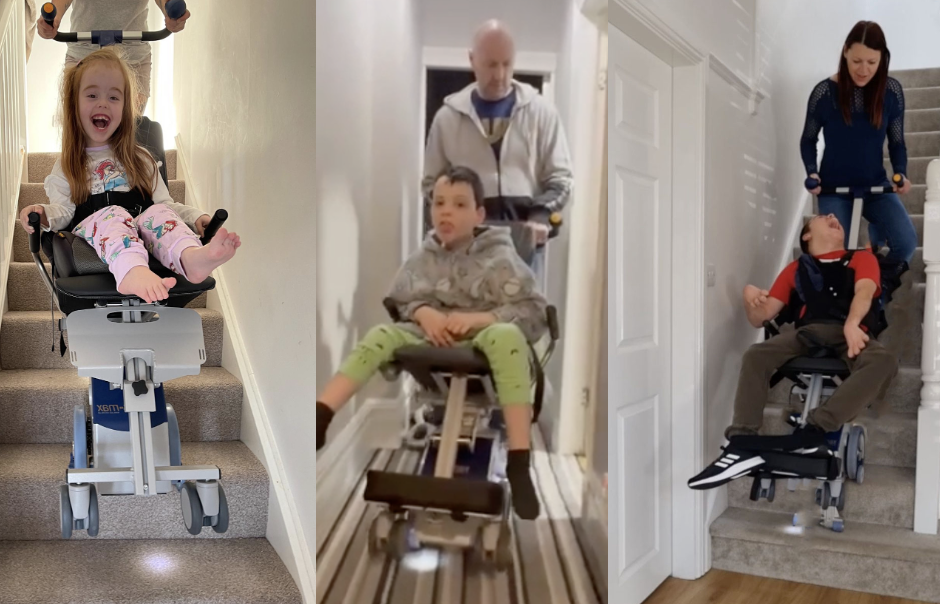
Sella makes stairway navigation safe for child and carer(s).
The child can move around their home securely and comfortably.
Their carer operates and has complete control of the transfer process, making stair navigation safer for them too.
Being a portable unit, Sella carries the child from the stairway on to destination.
The child is protected from the risk of a transfer at the top of the stairs, as would be inherent with a more expensive installed stairlift.
The stairclimber evolves with the child over time when paired with our unique Universal Seat System.
The seat system incorporates adjustable lateral, hip and head supports.
“Providing a stairclimber where appropriate identifies the risk earlier and prevents a problem from needlessly escalating- key elements of the Independent Review of Childrens Social Care,” says Peter Wingrave, AAT Director.
“Such investment in family help also improves the child’s outcome and can reduce spending later on.
"we have numerous instances where our Sella has been provided as the short-term solution to manage risk, but the family has insisted on keeping it, even when a more long-term (and often more expensive) option is available!”
Detail of how the Sella stairclimbing wheelchair works, and AAT’s re-issue package, can be found at
www.aatgb.com/s-max-sella/ and at http://www.aatgb.com/ots/.
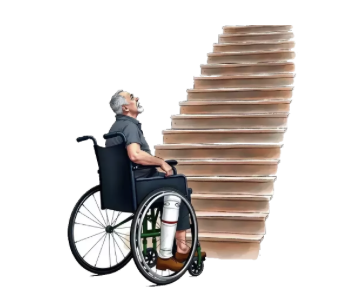
Almost every home has stairs, whether to gain access if a flat, or to move around the home if a house.
For the patient to be able to continue with their daily life, they need intervention. Delay waiting for modification causes bed-blocking.
Where appropriate, Occupational Therapists have an easy intervention available for prescription- an S-Max stairclimbing wheelchair.
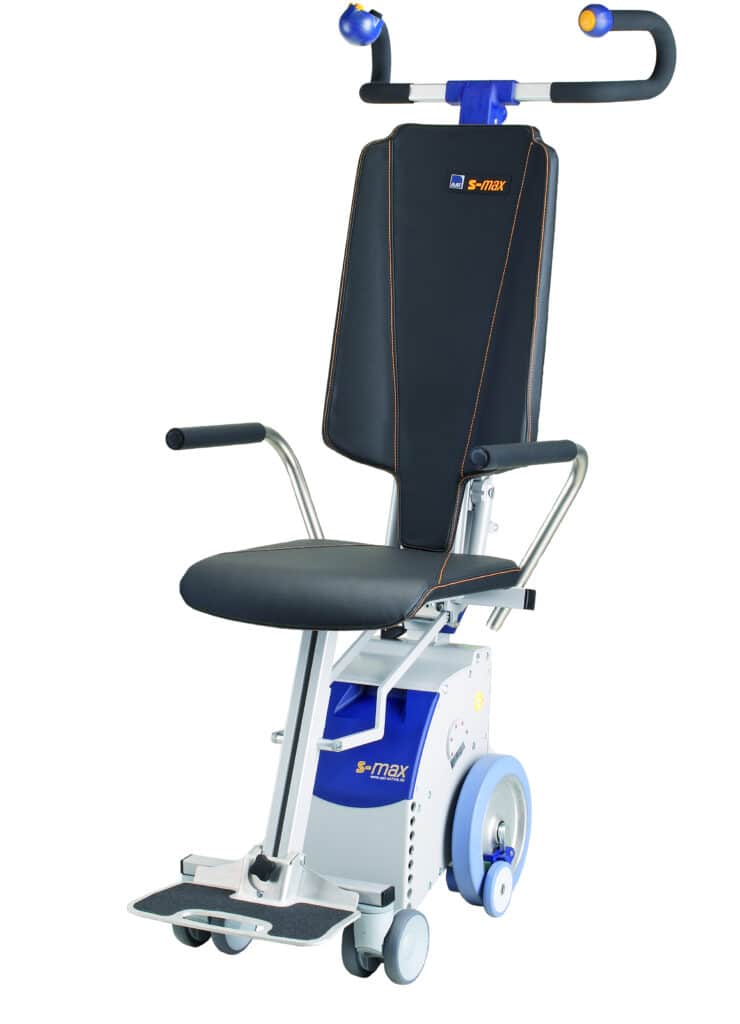
The battery-operated kinematic Class 1 Medical Device can either fit to a wheelchair or include an integral seat (the S-Max Sella), to safely transfer the injured person up and down steps and stairs. The person overcomes the barrier of wheelchair stair access.
There is no installation, fixing to walls, floors: all that is required is an hour or so’s training, provided by AAT.
Lightweight and mobile, the S-Max mobility stairclimber can be used by even the most petite operator. It folds away when not in use.
With the addition of a Universal Back accessory, any additional thorasic or pelvic support required can be achieved- whether for the initial recipient or future beneficiaries.
Most local authorities have the equipment already, so it is just a case of re-issuing from stores.
If one is not to hand, AAT’s assessment managers can visit the patient within days. A stairclimber delivered from stock within 3 days of receipt of order.
That purchase can then be used to support the specific person, then taken into stores and re-issued to others.
In this way, Occupational Therapists achieve a person-centred solution.
They manage risk of the injured person falling on the stairs.
Their client's environment and ability to perform routine occupations is also safely addressed.
Thus, Royal College of Occupational Therapists’ guidance on falls management(3) is followed.
And the person is discharged from hospital, releasing the bed.
“Prescribing a stairclimber is a best-value way to achieve a broad, holistic answer to a client’s ability to be discharged faster from hospital, and live home life better, with less disruption to routine,” explains Peter Wingrave, AAT Director.
“It is the most efficient way to overcome the issue of navigating stairs, removing all the danger of someone trying to go up or down on crutches (an accident waiting to happen), the indignity of bottom-shuffling, or them being confined to one level with all the disruption to them and the rest of the household in moving beds downstairs, commodes etc. With its re-issue capability, one stairclimber can help numerous people.”
Ful details of the S-Max, including videos on it in action, and an assessment booking form, can be found on AAT’s website: https://www.aatgb.com/s-max/.
references:
(1)https://www.jla.nihr.ac.uk/priority-setting-partnerships/broken-bones-in-older-people#:~:text=priorities%20Key%20documents-,About%20this%20PSP,as%20the%20population%20gets%20older.
(2)https://www.jla.nihr.ac.uk/priority-setting-partnerships/broken-bones-in-older-people/
(3)https://www.rcot.co.uk/node/396
AAT has always been committed to putting client safety first.
It is why we don't rely on a set of printed instructions, or a training video, whenever we provide one of our market-leading stairclimbers (stairclimbing wheelchairs).
It is why we have an impeccable safety record, stretching back over 20 years.
One of our team personally visits to formally train users of its equipment.
We spend as long as is necessary with each user to ensure they understand the process and are comfortable using the stairclimber.
The personal training applies whether a new purchase, or a re-issue/re-prescription.
The “hands-on” approach means any questions or issues are instantly addressed. It optimises safety.
Indeed, we have refused to provide the stairclimber if we felt the user was not competent or comfortable, or the environment was unsuitable!
“We have a duty of care, and I believe a moral obligation, to everyone involved in the sales process, to ensure we have done everything within our power to make stairway access easy and safe- for the passenger and the stairclimber operator. It’s about doing the job right.
"Client safety is paramount. The fact that we have not had a single negligence claim throughout our 20-year history is testament to that commitments” says Peter Wingrave, AAT Director.
Our stairclimbers are battery-powered devices that help people with impairments safely and comfortably navigate stairs with the support of a carer.
They are the most popular choice of stairclimbing wheelchair throughout the UK, chosen by almost every local authority in the country.
Why choose a stairclimber from AAT
- No installation, no structural changes—just plug and play.
- Effortless stair navigation: AAT powered stairclimbers handle single steps or full flights with ease- even tight turns and spirals!
- Comfort and safety built in. Our stairclimbing wheelchair range prioritises comfort and safety for users and carers—at home and beyond. We have an impeccable safety record stretching back two decades.
- Support that goes the distance: our free no obligation assessment considers all aspects- home environment, user and ‘operator’. We personally set your stairclimbing wheelchair up for you and spend all the time you need to ensure you are comfortable using it. In the rare event it won’t work, we’ll say so.
- Reliable after care: our team of highly trained engineers can service it on site annually and speedily effect any issues in the rare event you have a problem.
Key features:
- Adjustable to each user
- Completely portable
- Range of accessories for optimum comfort and security
- Re-chargeable battery- each charge delivers up to 390 steps(1)
To find out more about our range of stairclimbers and to. book your free no obligation assessment, visit http://www.aatgb.com/mobility-stairclimbers/.
(1)https://www.rospa.com/campaigns-and-fundraising/current-campaigns/safer-stairs

Because of a brain tumour, spinal fractures and osteoporosis, Mat Laban could not stand, walk nor weight bear.
One of his pleasures in life was a bath.
But the size and configuration of the family home in Bradford made it impossible for him to have that enjoyment any more.
Thanks to S-Max, Mat was able to safely and easily navigate the steps outside, feel the sun on his face, and enjoy fresh air—precious moments at the end of his life.
The transformation was made possible through close collaboration between Mat’s partner Jenny, the family’s Occupational Therapist, and AAT.
Using the S-Max in its Sella variant (with integral seat), Jenny could safely take Mat upstairs to relax in the bath in the way he loved- with a cup of coffee and a biscuit.
They weren't confined indoors any more!
Jenny used S-Max to take Mat over the front door’s raised threshold, down the stone steps to the pavement where he could transfer him to his wheelchair. This not only reduced the physical strain on Jenny but also significantly improved both their mental wellbeing.
When Mat’s condition worsened so external transfer was becoming difficult for Jenny, we stepped in again. We adapted S-Max to work with Mat's wheelchair, by removing the seat and adding brackets.
Jenny no longer had to lift Mat from stairclimber to wheelchair to go out and about.
And, as the Council already had the appropriate AAT accessories in its equipment stores, no additional funding was required.
“Mat was like the Duracell bunny- he just kept going. His legacy will be that our experience can help show other people facing a similar situation that with the right support and equipment, you do not have to be confined to the downstairs of your home,” says Jenny.
“I always say every day’s a school day: we’re always learning! Until you’re in that position, you’ve no idea what’s out there.
"The stairclimber was an absolute life saver, an amazing piece of equipment. It gave us some independence. Without that piece of equipment Mat and I would have had no way of leaving the house together.”
AAT’s S-Max Sella is unique in inter-floor transfer devices in that it is not confined to the stairway, and that one machine can both include an integral seat or attach to a wheelchair. Thus it provides a cost-effective and safe solution where stairs and steps are a barrier to daily life.
It requires no installation.
S-Max reduces transfers for the passenger and operator.
We personally assesses the passenger, operator and home environment to determine the suitability prior, including what accessories may be needed to ensure a safe, comfortable transfer process. AAT also personally trains the care giver(s) in S-Max’s safe operation.
Also uniquely, when the recipient no longer needs it, S-Max can be taken back into stores and re-issued/prescribed to another. It equates to less than £800/year(1) to gives multiple people and their families improved accessibility.
Full details of S-Max, including video of Matt and Jenny traversing their outside steps and how to book a free no obligation assessment, can be found @

The Council's achieved a green alternative to social care by allocating AAT’s Sella stairclimbers (stairclimbing wheelchairs), where appropriate, to clients needing help with stairs.
The Department used grant funding from the Council’s Green Investment Fund to purchase four Sella’s to provide an alternative to major adaptations that reduces the carbon impact of building.
In this way it has achieved a green alternative in social care provision.
Stairclimbers are mobile, portable devices- unlike conventional stair solutions such as stairlifts or through-floor lifts which require structural surveys, installation and building works. No building work is required.
The Department can re-issue-re-cycle the Class 1 Medical Device to another person when the original recipient no longer equires it. There are no building works to ‘make good’. The equipment's green credentials- and best value capital outlay- are enhanced.
To further extend the capability of the stairclimbers, the Department has also bought three of our unique Universal Seating System.
The Seating System combines back, seat, lateral and foot supports with safety harness. It ensures each user is completely supported and safe when being transferred up and down stairs.
Sarah Hole, Children’s Senior Practitioner Occupational Therapist for the Integrated Community Equipment Loan Service Clinical Team Nottinghamshire and Nottingham City Partnership, says:
“We historically have purchased AAT stairclimbers for use, where appropriate, with children and adults who have impaired mobility. The fact that they can be deployed quickly, with none of the impact of building work, makes them a useful alternative to major adaptations. It especially helps as budgets are under pressure and there is a drive to become carbon net zero.”
Dr Cate Bennett, Principal Occupational Therapist, Adult Social Care and Health at Nottinghamshire County Council, adds:
“The Principal Occupational Therapy role focuses on leading the quality assurance of occupational therapy practice, service development and improvement. It has a strategic and operational focus, and covers work within our organisation, and externally where it furthers the development of social care and occupational therapy.”
Mobilty is the biggest disability in the UK(2). Stairs are the second most common hazard in the home(3, and one of the three most common adaptations.
Our stairclimber re-issue capability(1) is unique in the inter-floor transfer sector, and is rapidly gaining momentum among local authorities nationwide as a cost-effective and quick way to keep people safe and in their own homes by managing the risk of stairs.
REFERENCES:
(1)https://www.aatgb.com/taking-steps-to-reduce-adaptation-delay-for-650-recycle/
(2)https://www.statista.com/statistics/449279/disability-prevalence-impairment-united-kingdom-uk/
(3)https://bregroup.com/press-releases/bre-report-finds-poor-housing-is-costing-nhs-1-4bn-a-year/

Help with stairs and steps is one of the top three most common home adaptations people need to their home(2)..
Our innovative S-Max Sella stairclimbing wheelchair (stairclimber) is unique in that, unlike the conventional alternatives, it addresses BOTH internal stairs and external steps when adapting a home.
Sella means that Occupational Therapists need prescribe only ONE piece of equipment to enable someone to access all levels of the home- inside AND out. They can use it for either or both scenarios.
OTs can re-cycle/re-issue it to another client when their original client no longer needs it- unlike the alternative conventional solutions.
We have put in place a specific service for social care providers to enhance that flexibility, whereby we manage the whole process for the OT.
That includes:
- assessment of the potential recipient
-assessment of their home environment to validate the suitability of the equipment
-training of the recipient’s carer
-stock-holding, servicing and commissioning of the equipment between each home adaptation.
Our package works out at less than £650/yea (3) over the 15 years’ average lifespan of the Sella helping numerous people in need of stair and step support in the process.
Director Peter Wingrave says:
“The Government’s package of support as part of its Plan for Change acknowledges the two-edged sword of the need to take preventative steps that help people remain in their homes, out of hospital and that we have an ageing society."
“Our package of support provides a best value option to address one of the most common changes required to a home. There may be extra Government funding in the pot, but it makes sense to optimise the value of every £. That way, more people can be helped to stay in their own homes.”
Full details of our S-Max Sella and package for social care providers can be found here: https://www.aatgb.com/ots/.
You may also like:
https://www.aatgb.com/taking-steps-to-reduce-adaptation-delay-for-650-recycle/https://www.aatgb.com/cradle-to-grave-evolution-simplifies-speed-and-safety-on-stairs/


