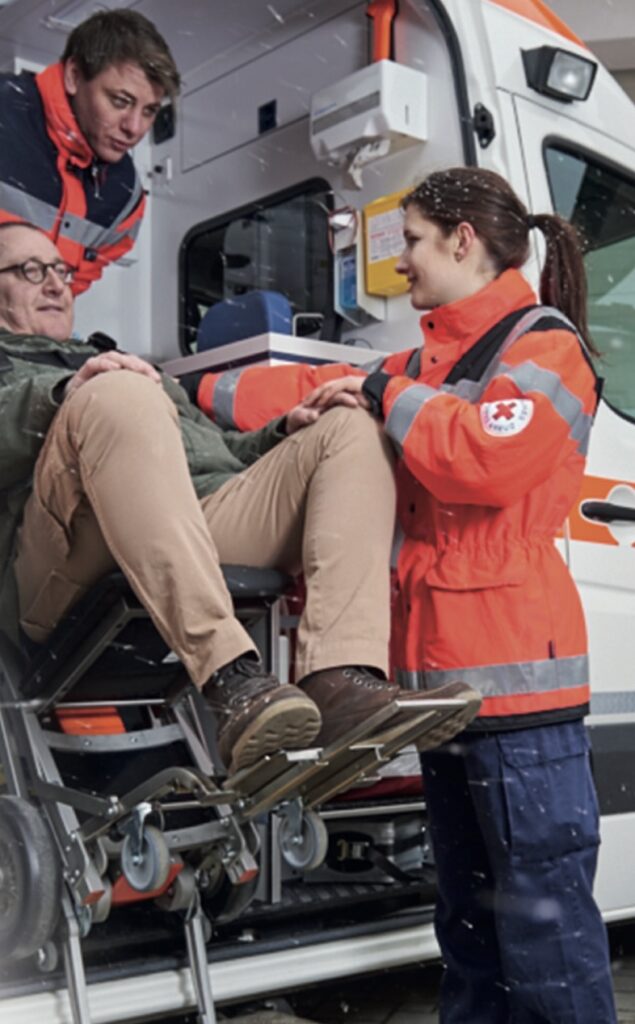
Back and musculoskeletal problems are the 2ndbiggest cause of absence(1), many the result of bed-to-bed transfer. AAT- Britain’s leading provider of stairclimbing wheelchairs- has a solution.
C-Max U2 ambulance stairclimber is becoming an established bed-to-bed transfer device: hundreds are already in use from one end of the UK to the other.
What sets the battery-powered C-Max above alternative means of safely manouevring patients from home to ambulance to hospital is its ease of use and reduction of risk to patients and crew.
The machine has an integral seat and safety belt, and a unique crash-tested locking mechanism/ battery charger for within the ambulance. Thus, the paramedic team need only execute one transfer of the patient at each end of the journey. The C-Max safely transports patients up and down stairs and steps, and into and out of the ambulance. C-Max can navigate 25 flights of steps from a single battery charge too.
C-Max enables the patient transfer process to be executed by just one or two team members, depending on operational protocols. It can accommodate patients up to 140kg, whilst its bariatric version C-Max CR230 can address weights up to 230kg.
C-Max thereby reduces loading and strain on staff, significantly cutting work-related injuries and sickness and consequent costs.
Accessories including holding devices for oxygen tanks and a Universal Back to ensure every patient can be supported and secured during the transfer process are available.
When not in use, the C-Max U2 folds to stow compactly away, optimising space.
“The business case for using a stairclimber in ambulances is irrefutable,” says Peter Wingrave, AAT Director. “Numerous Services from Scotland to Devon have already adopted the C-Max. They are seeing proven, tangible improvements in both customer satisfaction, improved passenger safety during transfer, and staff health & wellbeing.”
Added Louis Nicholls, Patient Transport Officer at Torbay and South Devon NHS Foundation Trust, which now has 10 C-Max's: “The stairclimbers not only help our team to support people with limited mobility, but more importantly allow us to offer a higher level of service for people across Torbay and South Devon.”
Full details of AAT’s solutions for ambulance are available on a dedicated section of its website: https://www.aatgb.com/ambulance/.
ENDS


