The equipment is our Sella mobility stairclimber, prescribed through the Occupational Therapy service at Ainsdale Centre for Health & Wellbeing.

Dad Paul says that our Sella has made a massive difference to family life normality: Isaac can have a bath again, sleep in his own bed in the room he shares with his brother, and they have space and freedom to be a family downstairs.
Isaac , 9, was born with Cerebral Palsy and has dystonia. A mistake during brain surgery meant to improve his quality of life made Isaac’s condition worse: he became less able and heavier.
Paul and his wife Rachel were struggling to carry Isaac up and down the steep stairs in their Victorian home.
The only answer for everyone’s safety until a solution was found was to move Isaac’s hospital bed into the front room.
The family’s Occupational Therapist Helen Murphy appreciated the family’s desire for Isaac to be able to access upstairs, to be in his own bedroom and be able to bath.
So she reached out to us to assess Isaac, the family and the home environment to determine whether our Sella mobility stairclimber would be appropriate.
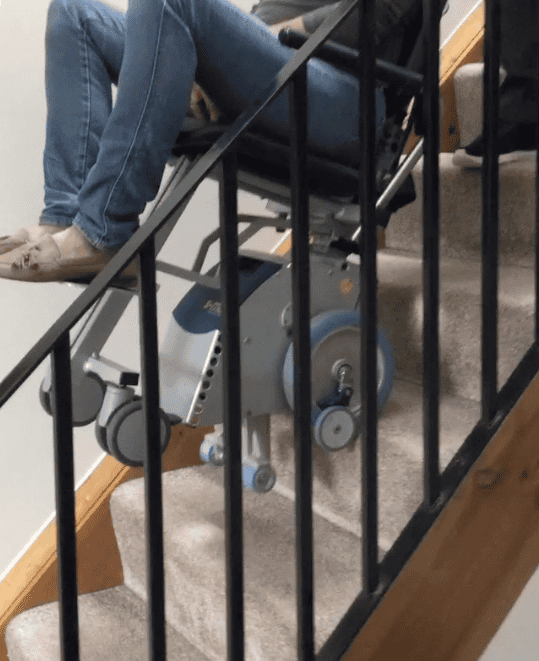
Sella worked! Paul and Rachel found it easy to transport Isaac up, down the stairs and on to their final destination- the bathroom, bedroom, lounge, with no need to lift/transfer Isaac en-route…
Sella is the UK’s top-selling mobility stairclimbing wheelchair. Its light weight, high balance point and automatic braking make it easy for Paul and Rachel to use.
Sella’s in-built seat, arms and lap belt mean Isaac is always safe and comfortable, even if he has a dystonic episode whilst on the stairs.
For the family, it was an added bonus that AAT made the effort to deliver the Sella the week before Christmas.
“It made such a difference to our Christmas celebrations!” says Paul. “Isaac could be with his siblings upstairs and have a stocking at the end of his bed on Christmas morning. We were able to celebrate as a family, with space, in the front room.”
Adds Paul: “We know life will never be ‘normal’, but we want Isaac to do as much as he can. Little things like being able to have a bath, which he loves, and to be with his brother and sister upstairs make all the difference. Now he can do those things again, because we can safely get him up and down stairs with the stairclimber.
“And hopefully, in the summer, we can use it to get him out into the back garden too!”
Full details of the Sella stairclimbing wheelchair, how it works and how to book a free no obligation assessment can be found @ www.aatgb.com/s-max-sella/.

For OTs to achieve the goals of Housing Without Delay, making stairways accessible is therefore a critical priority
Only AAT can deliver stairway access without delay.
The Sella stairclimber, AAT’s top-selling model, is typically funded through equipment budgets and requires no installation. This means:
All that’s needed is a PEOP assessment to ensure suitability.
Unlike fixed stairway solutions, the Sella is fully portable. It can be used across multiple staircases—indoors and outdoors—enhancing both physical and mental wellbeing for the client.
Its design also reduces the need for transfers between seats, wheelchairs, and stairlifts. Once the stair transfer is complete, the carer can continue onward without moving the client from the Sella, supporting the carer’s wellbeing as well.
Most local authorities already own at least one AAT stairclimber. When no longer needed by the original user, it can be re-prescribed, recycled, and re-issued quickly and affordably.
The total cost—including PEOP assessment, servicing, and 1:1 carer training—is under £1,000. This enables timely preventative action without major capital expenditure.
No other stairway access provider offers this level of flexibility and value.
🔗 Learn more about AAT’s stairclimbing solutions: www.aatgb.com/s-max-sella
🔗 Explore the Housing Without Delay initiative: Foundations UK
REFERENCES
(1)https://www.foundations.uk.com/beyond-adaptations-launching-housing-without-delay/
(2)https://bregroup.com/press-releases/bre-report-finds-poor-housing-is-costing-nhs-1-4bn-a-year/
(3)https://www.rospa.com/campaigns-and-fundraising/current-campaigns/safer-stairs
Already, almost 1million people have dementia. Half of the UK population will be dealing with dementia in our lifetime(1).
Only 7% of our homes have key accessibility features such as a ground floor WC.
Dealing with dementia and its impact mobility and movement means that even something as mundane as going up, down stairs- to bed, to bath, to use the toilet- becomes difficult.
It can even be potentially dangerous.

You can manage the risk, quickly and easily.
And you can do it without any of the delay usual with a home adaptation, and without impacting on how others in the household can use the stairs.
Our S-Max Sella stairclimber/ stairclimbing wheelchair is a portable, mobile unit that folds compactly away when not in use.
Class 1 Medical Device certified, Sella provides a proven, safe, supported way for you, the carer, to take the dementia patient up and down stairs- and beyond.
Familiar routines can be preserved. Mobility and movement around the home is restored.
You don't need to transfer your loved one from the Sella at the top or bottom of the stairs. Sella continues the journey onwards to whichever room, further improving safety.
Sella is battery-operated. Each charge delivers sufficient power to undertake 300 steps. You have complete control over the speed.
You can pause the step process en route. Sella automatically smoothly brakes at the top of each riser to maintain complete operator control.
We support your Occupational Therapist in assessment of the home environment, dementia sufferer and their carers to ensure all are comfortable with the kit.
We also set up the Sella to suit each person involved and train you in how to use it.
Julie Murray was given a Sella to help her with her husband Robert who has dementia.
Their OT realised the only way the family could get Robert up, down stairs to bed and bathroom was on son Harry’s back!
Julie says, “The Sella has changed our lives! It’s made daily life so much safer. It has meant I can keep Robert’s routine, life, as normal as possible, getting him up to bed.
"With only having one toilet at the time, upstairs, the Sella meant I can get him there in time.
"And even with a wetroom downstairs now, the Sella is still in daily use, getting Robert up in the morning and to bed at night.”
Full details of Sella, including how to book a free, no obligation assessment, can be found here:
https://www.aatgb.com/s-max-sella/.
(reference: (1)https://dementiastatistics.org/about-dementia/prevalence-and-incidence/)
You may also be interested in:
https://www.aatgb.com/deal-with-steps-and-stairs
Where relevant, changing the mindset from providing a person to providing equipment that does not need Disabled Facilities Grant (DFG) funding could radically reduce the number of people waiting for care support. It could cut the cost of care.
With the continuing lack of staff, people in need are left struggling to live daily life with any degree of quality.
As importantly, the staff themselves are exposed to greater risk as their workload increases.
Unpaid carers too are being put at risk by having to manage without support.
By using the right equipment- where relevant- to reduce the reliance on carers-paid and unpaid- mean that clients would be more independent and have a better quality of life.
Strain would also be reduced on the care workforce, enabling them to deliver better quality of care for those instances where kit is not appropriate.
Using equipment would reduce the risk of unpaid carers injuring themselves lifting, moving, handling. These actions put further strain on the paid care workforce who have to step into the breach.
And it needs to be the right equipment- that achieves the end purpose for the client, safely, and that can be expediated without delay.
Says Peter Wingrave, AAT Director:
“There is a mindset within social care that if someone is struggling with stairs, then you put in a stairlift (or a through-floor lift). Yet that requires DFG funding, which takes months, years to fulfil.
"Inbetweentimes, the client is left with a compromised living space and little or no privacy if a bed has been moved downstairs- assuming that can be done- or their access to areas of their home- bedroom, WC etc- is wholly dependant on the availability of a carer- paid or unpaid- to help. It also puts that care giver at risk.
"“Most local authority equipment stores have at least one stairclimber, that can be delivered to the client, and their caregivers trained on its safe operation, within days.
"Thus the risk to all parties is minimised, fast and cost-effectively. The need to provide paid care is reduced/eliminated.
"As an added bonus, when that client no longer needs it, the stairclimber can be re-prescribed (recycled) to another, achieving best value and best use of resources from every relevant perspective.”
Our mobility stairclimber is battery-powered devices that help people with impairments safely and comfortably navigate stairs with the support of a carer.
Unlike alternative equipment that is fixed to the structure of the home, our stairclimber is portable. So, when no longer needed by the original recipient, someone else can use it.
We offer a free, no obligation assessment service to determine the relevance of its kit for each potential client, including their care-giver and staircase.
We have an unrivalled safety record for its equipment, stretching back over 20 years, with thousands in regular use up and down the country.
Full details are available on our website www.aatgb.com/sella.


