What equipment to help with stairs for your special needs children and your family, especially once they are too big to be carried around…?
In an ideal world, you’d adapt the home or re-house the family into somewhere more suitable.
The reality is that takes time, if it’s even possible, and you have a duty of care to manage the risk- whether for the short- or long-term.
I say even possible because the truth of the matter is that:
-80% of the homes we need by 2050 are already built.
-20% were built before 1919 and
-50+% are conjoined (semi’s or terraces).
Most homes are houses: they have stairs!
Are they structurally suitable to be adapted- in their design, space, wall strength etc? Is there space outside for an appropriate extension?
And we all know, all too well, the issues with social housing waiting lists.
From a practical perspective, the issue is complicated by the fact that often the children lack control over their bodies.
You have to take into account the likelihood of their thrusting arms or legs out, flailing, spasms and seizures.
You need a way to overcome the need to access up and down stairs, safely. It's hard for you to negotiate a dozen or more steps with the weight of your child in your arms. It's hard when you are trying to maintain balance with a child who most likely is not lying there quietly without moving.
There are four core choices: move your child’s bedroom downstairs, a stairlift, a through-floor lift, or a stairclimber (stairclimbing wheelchair).
Your choice is influenced by:
It seems the logical option, as it instantly removes the issue. But it is dependant on the size and scope of the home.
You need to be space to accommodate your special needs child’s bed and all their accoutrements.
What about the impact this has on them, and, as importantly, other member of the family in everyone’s use of the home and daily activities?
It also means your child’s personal space and privacy is adversely impacted.
Many parents do not like their child being so far away at night, in case they are needed.
You also need to have at least a downstairs WC and ideally either an existing bathroom, or the scope to add one.
If you don't have these in the existing layout, often an extension (permanent or relocatable) is added, but again there needs to be the external space to accommodate that, plus access to drains, electricity etc.
This is your ‘go to’ conventional solution in adaptations.
However it depends on the staircase design and the structure, specifically whether is strong enough to bear the load. That requires a survey. That equals delay.
Today’s versions are available with child accessories- seats, harnesses, foot rests etc.
Remember, for your child to use it safely, they need mobility, sitting balance and control over their body movement.
He/she is sat perpendicular to the stairs. You need to be sure there is no risk of them sticking out a leg or arm that may catch on the banister and newel posts, nor panicking.
It is a permanent fixture, physically attached to the building fabric, so therefore restricts unimpeded stairway access for others in the household.
Through-floor lifts, as their name implies, require a suitable space both upstairs and down- on average, 1m2 as a ‘footprint’, with a ceiling height of at least 2.1m.
They require cutting of a hole in the ceiling/floor. They require a survey to assess the property’s suitability.
Models can accommodate someone in a wheelchair and a carer. You have to be confident both can fit inside comfortably and safely, whether your child is in a wheelchair or being carried.
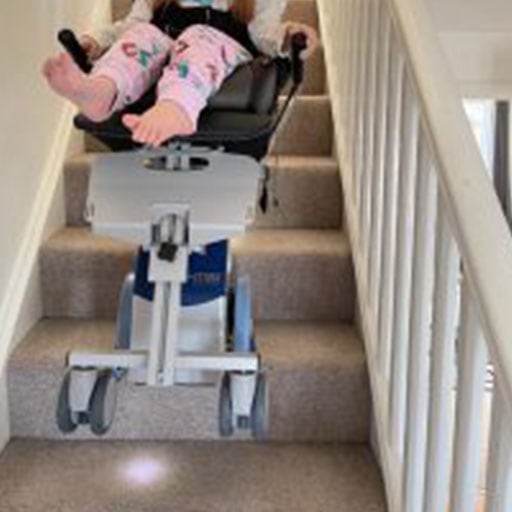
A battery-operated free-standing, portable, mobile unit that can be attached to the child’s wheelchair or have an integral seat.
You don't need a structural survey to assess for weight-loading as the stairclimber is a portable piece of equipment, it is not fixed to the structure.
Capable of climbing most common staircases, it can then taking your child onwards to other rooms within the house without an additional transfer.
You achieve a safe stairway transfer solution within days of assessment.
Your child is transported in line with the stairs, slightly inclined backwards reducing risk of panic and the risk of arms, legs getting between newel posts.
When you're not using it, it folds compactly away and can be stowed in a cupboard.
Your child is comfortable, safe and secure when using the equipment as it can be accessorised to suit their individual needs.
The S-Max Sella stairclimber
Class 1 Medical Device certified, the Sella is the only stairclimbing wheelchair which is backed up by full, nationwide sales and service support and with a track record stretching back 20 years.
The Sella stair walker is the market leader, with more than 5000 units in use with Local Authority and NHS Trusts across the country.
It is also the only stairclimber with a bespoke, purpose-designed all-in-one paediatric seat- the Universal Back.
Our Universal Back, developed with Occupational Therapists, features head, lateral and seating supports and harnessing.
We can precisely set the accessories exactly as your child needs for optimum comfort, postural support and alignment, and physical and emotional security.
As your child grows, we can adjust the supports.
And, if your child is likely to have. seizure, don't worry!
You can safely brake and pause the Sella at any point during the transfer.
We show you how in the 1:1 training we give you in your home as part of the process.

All you need in addition is training by a qualified professional: we check and service the Sella as part of the re-issue package.
There is none of the inevitable ‘making good’ of the home required with stairlifts, through-floor lifts.
That all helps you persuade your OT to prescribe one!
You can see it in action here: www.aatgb.com/s-max-sella.
I would hope you now feel more aware of the options, how they differ, and how to make stairs safe for a special needs child.
I have shown you how to manage the risk and make accessing the home safe for all involved, whether for the short- or long-term.
Our website has a raft of support material that may help, including user testimonials, videos, and guides. And you can book a free, no obligation assessment: https://www.aatgb.com/mobility-stairclimbers/
Author: Gareth Brown, AAT Technical Director
You can find out more about our Sella stairclimber here: http://www.aatgb.com/s-max-sella/
Want to know why to choose the Sella? Ewe've identified six reasons why: https://www.aatgb.com/six-reasons-why-to-choose-a-sella-stairclimbing-wheelchair/
You may be interested in:
https://www.aatgb.com/disabled-children-and-stairs-an-accident-waiting-to-happen
https://www.aatgb.com/steps-and-stairs-overcoming-the-obstacle/
and https://www.aatgb.com/family-chooses-quick-fix-tech-as-the-ideal-long-term/


