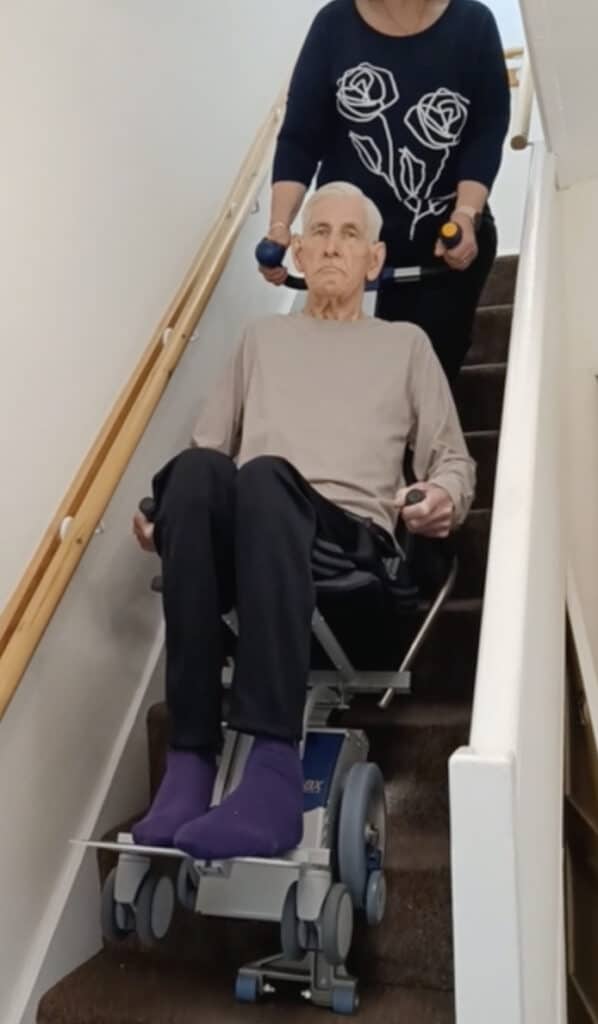
Stairs- or our ability to use them- is one of the biggest issues facing people with limiting conditions, whether a short- or long-term problem, whether in a flat or house.
They are one of the main reasons disabled people need to move to accessible housing if their home is structurally unsuitable for an adaptation such as stairlift or through-floor lift.
Where appropriate, provision of a stairclimber could turn existing inaccessible homes into accessible homes.
AAT’s S-Max Sella- Britain’s top-selling stairclimbing wheelchair- is a stand-alone, mobile, battery-operated Class 1 Medical Device certified mobility aid. It can be supplied with an integral seat or fixed to a wheelchair.
The S-Max Sella has been designed and engineered with the capability to accommodate almost all staircase designs, even turns or narrow flights.
It does not require structural fixing or alterations. Because it is not fixed to the building fabric, one stairclimber can solve stairway access in townhouses, blocks of flats, or where external egress is impeded by steps.
It also does not impede the stairway for other users of the house or block of flats. All it requires is someone who can operate it (whom AAT trains to LOLER standards as part of the service) to safely transfer the limited person up and down stairs, such as the person’s resident carer.
And the cost of providing the kit can be almost negligible. Most local authorities already have at least one as part of their community equipment. Further, the Sella can be re-prescribed to another user when the original recipient no longer needs it, without any of the time, cost nor disruption of ‘making good’ with a permanent fixture.
Says Peter Wingrave, AAT Director, “I appreciate the solution depends on a number of variables. I accept it is not an answer in every case. But surely we should at least consider alternative ways to use already available resources, to address the hardship being faced by so many and avoid further encroachment on green belt?”
Full details of the stairclimber, including how it works video, can be found @
ENDS
References:

You don’t have to be a rocket scientist to know that the UK is facing an accessible housing crisis.
In social housing alone, more than 50% of tenants have a long term illness and impairment with a similar number who need an adaptation not having it.
Add to the equation that 1million households waiting for social housing(1).
And less than 10% of UK houses are deemed ‘accessible”(2).
The wait for adaptations has reached “devastating” levels of delay.
It begs the question: are we going about it in the wrong way?
Is there a better, quicker way to convert inaccessible homes into accessible ones?
The core criterium of the most basic level of accessible homes (Category 1, Building Regulations Approved Document M) is that ”reasonable provision should be made for people to gain access to, and use, the dwelling and its facilities”.
The Government has pledged to make all new build homes “accessible and adaptable”, but new build is not keeping up with demand, and the legislation does not affect existing homes.
So, if the rule of thumb is that outlined above- reasonable provision for people to gain access to and use the home- do you have a way that can be achieved, quickly, easily, cost-effectively?
I would claim there is: a stairclimber.

This one piece of portable mobility equipment overcomes any barriers of steps, stairs, non-level thresholds.
Almost all local authorities have at least one already in their equipment. If not one to hand, the social housing provider or private individual can get one within a working week of order.
In a social housing environment, when no longer needed by one user, you can “re-issue’- give it to someone else, to help them access the home and regain independent living thus helping achieve best value.
A stairclimber requires no installation. This is especially important in flats, which now account for 20% of our housing stock, with their common parts and the need to give all residents safe use of stairways.
All you need is assessment of the client and their carer by an appropriate professional. This ensures they are capable and comfortable using the equipment, and training of the carer in its safe operation.
With a stairclimber, you manage the risk of the client or their carer falling whilst trying to negotiate varying levels, steps, stairs.
The equipment itself has an impeccable safety record and is proven by some 20 years’ use in the UK with thousands in daily use across the country.
So, is it time for a step change in how we view ways to make housing accessible?
As I’ve outlined above, it isn’t hard. It just requires an email, phone call, or mouse click to start the process:
sales@aatgb.com, tel 01978 821875 or https://www.aatgb.com/s-max/.
ENDS
References:
Yet, there is already equipment available that could avoid the move. Further, there would be no requirement for adaptation, with all the associated cost/structural disruption.
The equipment is a mobility stairclimber- a powered, seated climbing device that is steered and controlled by the care-giver to safely transfer the person with reduced mobility up and down stairs and steps.

The variety of designs available means there is an option to suit every person- young to elderly- and every configuration of stairs, including turns, narrow flights, half-landings, spirals (https://www.aatgb.com/mobility-stairclimbers/).
So, whether a staircase in the home or couple of steps down from door to street, the person- whether adult or child- can continue to live in their home, and, importantly, still access their wider community.
You can even go away on holiday without having to book specialist accommodation.
When not in use, the stairclimber folds compactly away.
AAT stairclimbers have an impeccable safety record.
They can be used by the most petite care-giver, and move bariatrics.
“We continuously hear about the lack of accessible housing, and people having to leave their homes because they can no longer manage the stairs.
"A stairclimber can, in appropriate circumstances, enable people to live as normal in their homes, without the spatial limitation, impact on family life, cost, structural alterations inevitable with alternatives (a stairlift, through-floor lift).
“It’s a no-brainer. It not only prevents someone who becomes physically disabled having to leave their home. It opens the door to the hundreds of thousands of empty/ perceived inaccessible homes being put to use.”
Peter Wingrave, AAT Director
Our stairclimbers can be privately purchased, or funded through the local social services.
We are unique in offering nationwide support, including assessment of the potential users (ourselves or in support of an Occupational Therapist), full prescription of an appropriate stairclimber solutions, care-giver training, and servicing.
We can further deliver a full supply and management service for housing providers, including hire and purchase options.
Whether just a sign of getting older, or because we’ve had an illness that has affected our mobility, getting up and down steps and stairs is a daily issue.
It’s an issue that can have a huge impact on our quality of life, whether something as simple of going upstairs to the bathroom, or out and about.
Whether just a sign of getting older, or because we’ve had an illness that has affected our mobility, dealing with steps and stairs is a daily issue. It’s an issue that can have a huge impact on our quality of life, whether something as simple of going upstairs to the bathroom, or out and about.
All too often, short-term, the advice/answer is to move a bed downstairs.
That affects not just your feeling of privacy, but impacts on other members of the household too, and the whole family’s ability to live life.
Depending on your home, you may not even have a WC downstairs, with the consequence you may have to use a commode.
Even if short term, whilst a more permanent (and disruptive) adaptation such as a stairlift or through-floor lift, goes through the process, it could still be months of inconvenience and lack of privacy.
That’s assuming your home’s design, layout and footprint can accommodate a stairlift or through-floor lift….
A huge number of us also live in homes that have at least one step to navigate in order to go beyond the front- or back- door. Limited mobility can make even a single step an in surmountable barrier to our ability to enjoy the garden.
We are by nature on the whole sociable animals, who want, and need to interact with others.
Stairlifts and through-floor lifts enable us to still have quality of life at home, to still access all areas.
They do not enable us to venture into the wider community.
Until your mobility is reduced, you don’t realise how many shops, cafes, restaurants etc are still not “accessible” i.e. have either level or ramped access.

Stairclimbers are growing in popularity, and increasingly becoming the first choice for “inter-level transfer” by healthcare professionals. (As an aside, they are widely used by ambulance crews as the best means of moving a patient up and down stairs. It’s an added bonus that such equipment means one person, or ambulance team, can safely move a bed-ridden and/or morbidly obese person eliminating the need to send two crews to phsyically, manually manage the transfer.)
Stairclimbers can accommodate almost every design of staircase, even accommodating narrow flights, turns and landings having the smallest turning circle available in such equipment.
The battery powered unit features patented kinematics that continuously and smoothly power the unit and its passenger up and down stairs, without effort from, and at a pace set by, you the operator.
When not in use, it folds compactly away to optimise space within the home and minimise inconvenience to other family members using the stairs.
The kit is light and compact enough to fit in your car boot, and can be used outside.
The latest version to come to market is the tracked Roby, which transforms a standard wheelchair into a stairclimber.
People who have stairclimber love the independence they bring.
Paul Wray has had one for ten years for his 24 years-old daughter April.
His AAT S-Max stairclimber has moved to three different homes with the family, each time coping with the varying stair configuration (currently with a turn).

“The stairclimber is essential, I wouldn’t be without it, there’s no other way of safely getting April up and down stairs,” said Paul. “Carrying her up and down stairs was a recipe for disaster. The stairclimber made it safe, for me and April. It’s good for the whole family: when we’re not using it, the S-Max stows away. With three other children too, it can be a very full house at times! It doesn’t visibly impact on the household like a stairlift or through-floor lift would. One of the other beauties is we can pack it into the car for family holidays, widening the choice of where we can stay.”
Paul Wray
Jodie Bostock has a stairclimber for her young son Daniel, who has Cerebral Palsy.
He requires 24 hour care and has a team of care-givers- all of varying stature- to support him.

“The stairclimber is so easy, everyone can use it- whether it’s Daniels’s dad who is 6ft 3ins to his smallest carer who’s only 4ft 11 ins. Crucially, it supports and holds Daniel safely and correctly. It just works for us.”
mum Jodie


